Gut Oggau
The Free Bacchus Story
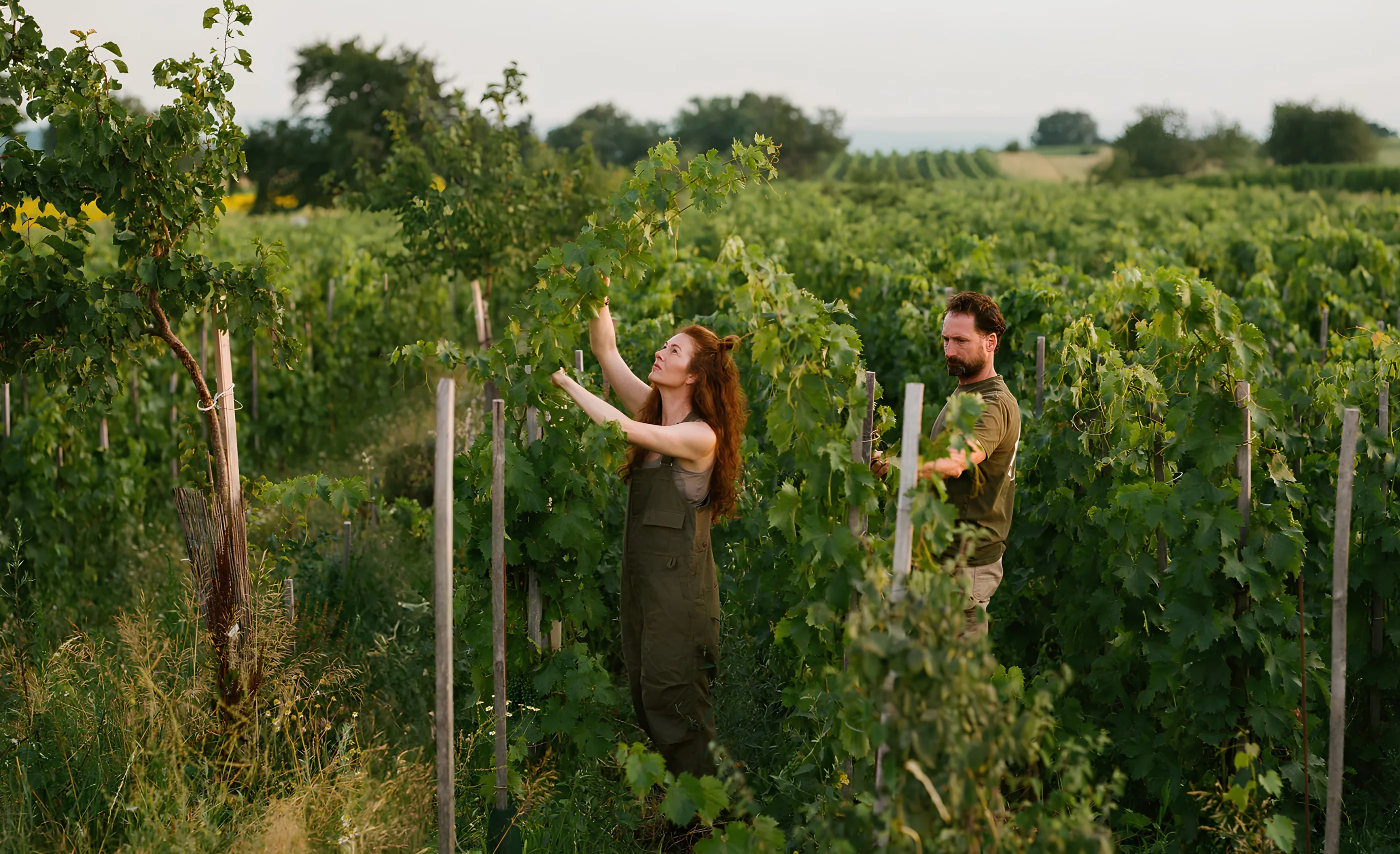
When Stephanie and Eduard Tscheppe bought Gut Oggau in 2007, it was a long-abandoned estate on Austria’s Neusiedlersee with a decrepit cellar. They took it on, they told the writer Simon Woolf, because the place had “a good spirit”. Eduard came from a winegrowing family that had made wine the conventional way, further south in Styria, but the couple felt that approach could not be grafted onto Oggau. Stephanie came from a family of restaurateurs and had trained in photography. They took up biodynamic farming out of conviction, in their own words, and set out with “a pinch of naivety” on what they call “an exciting, stony, steep path”.
Oggau lies on the lake’s western shore in Burgenland, about an hour from Vienna. Burgenland is Austria’s red-wine country, and the Neusiedlersee, a steppe lake barely more than a metre deep, holds the summer heat late into the season. Two Austrian grapes run through the range. Blaufränkisch, the red, sits somewhere near Syrah for pepper and near Pinot Noir for weight, with acidity that keeps it upright. Grüner Veltliner, Austria’s own white, is dry and medium-bodied, with a savoury, peppery edge where German Riesling runs to citrus. Most of the wines are field blends, from vineyards where several varieties are grown and picked together, and each label names a person, not a grape. What sets them apart in the glass is how they are made. Gut Oggau calls them natural wines and says what it means by that: they ferment with the yeasts that are already there, they are not filtered or fined, and no sulphur is added. Some of the whites spend days on their skins, as red wine does, which gives them more colour and grip than a standard white, and a bottle may be cloudy or carry sediment. The estate calls that a sign the wine is alive, not a flaw.
Each wine of the family wears a face on its label, and none of the faces is real. The estate presents its wines as an invented family of three generations: Theodora, Winifred and Atanasius are the young ones, six more are their parents, and Mechthild and Bertholdi are the grandparents. Each face, the estate says, is the impression a wine made on the couple. Eduard told Woolf the faces go back to the first vintage, which felt so alive as it matured in the cellar that the couple came to think of the wines as people.
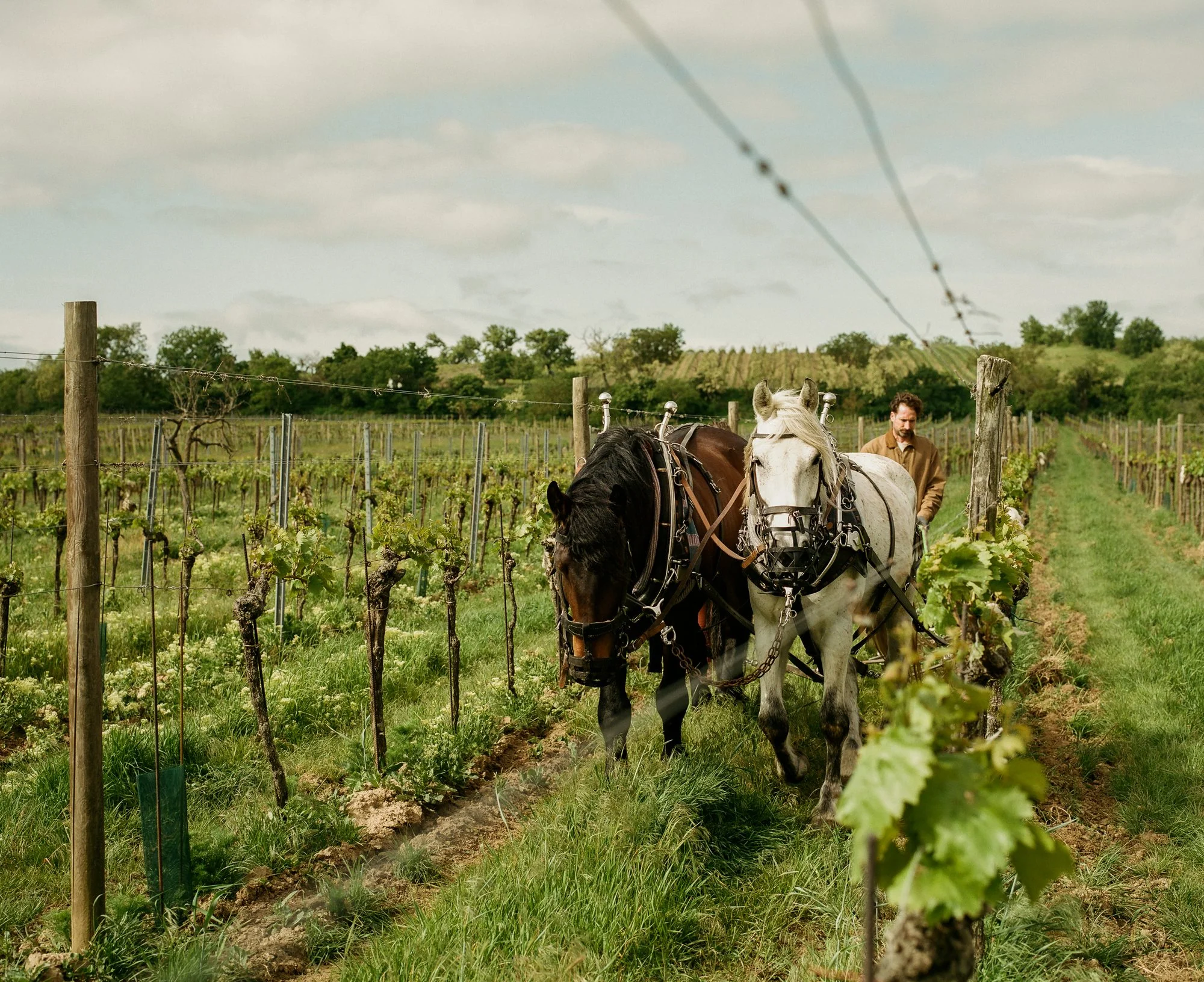
The vines are worked by hand and with horses. It is slower, the estate says, and that is the point. The grandparents come from its oldest vines, seventy years old, up on the plateau on limestone and schist at 300 metres, cropped at 15 hectolitres a hectare. Mechthild is a Grüner Veltliner and Bertholdi a Blaufränkisch. Both go in as whole bunches, stay fourteen days on their skins and then spend twenty months in 500-litre casks. A generation down, Aleks Zecevic of Wine Enthusiast gave the Timotheus (Weiss) 2022, a white field blend, 95 points in 2024 and called it stunning, with a light body and substantial texture.
Demeter Austria, the national biodynamic body, lists Gut Oggau KG, the company that farms the vines and makes the wine, on its grower list of June 2026. LACON certifies that company and Gut Oggau - Tscheppe GmbH, which sells the wine, as organic. Both certificates also record production in conversion, the farm’s for grapes and the sales company’s for wine, so some land and some wine are still in conversion, and neither says which. No register gives a start date. The EU’s first record for the estate is from January 2024, under an earlier company name, and the Demeter records carry no date at all. The date here rests on a journalist’s report instead. Simon Woolf wrote on 25 April 2013 that Gut Oggau was Demeter-certified, and Free Bacchus counts the wines as certified from the 2013 harvest on, on the strength of that report. Eduard told him the certificate mattered as proof of intent, and the Mechthild 2022 still carries the Demeter mark on its back label, beside the EU organic leaf.
“it was like having living persons in the cellar”
Why it’s remarkable
Free Bacchus Verification
Demeter Austria · LACON EU organic · some land and wine in conversion
Certified3
- Demeter biodynamic, Demeter Austria: Tscheppe Stephanie Gut Oggau KG, Oggau am Neusiedler See, processor and producer (BFDI AT-4671953), on Demeter Austria’s grower list of 1 June 2026 as Gut Oggau KG
- EU organic, LACON (AT-BIO-402): Gut Oggau KG, Oggau (AT-BIO-402.040-0030790.2025.003), production and preparation, grapes and wine, valid 18 December 2025 to 31 January 2027
- EU organic, LACON (AT-BIO-402): Gut Oggau - Tscheppe GmbH, Oggau (AT-BIO-402.040-0030731.2025.004), preparation, placing on the market and export, valid 11 December 2025 to 31 January 2027
This page covers
The KG’s certificate records grapes as both organic and in-conversion production, and the GmbH’s product list names wine ‘In-conversion’ as well as ‘Organic’
Not covered1
- Land and wine in conversion: neither certificate says which
Also on record3
- The Demeter certification is dated from the 2013 vintage by Simon Woolf’s report on timatkin.com of 25 April 2013 that ‘Gut Oggau is Demeter-certified’, which no register carries
- The EU register’s earliest certificate for the estate is from 9 January 2024, held by the predecessor Weingut Tscheppe-Eselböck KG
- BFDI lists the KG only, with the certification status ‘Other’ and no validity date, as for every Austrian record
If you’re buying
Cheat sheet
Save it to your phone. Everything you need to recognise this producer, and three things worth saying about it, at a glance in a shop or across a table.