Free Bacchus Journal
Organic, Biodynamic,
Natural what the words mean
Four terms, scattered across labels as though they were interchangeable. They're not. Two come with an auditor who can take them away; two don't — and knowing which is which takes about ten seconds once someone tells you.
Walk into any wine shop and you'll meet the same four words. Organic. Biodynamic. Natural. Sustainable. They sit in similar type, in similar places, often near a similar line drawing of a leaf, and the arrangement invites you to treat them as rough synonyms. They aren’t synonyms. Two are backed by legal standards and annual third-party audits. Two are backed by the producer’s good intentions.
Almost nobody standing in that aisle has been told which is which.
That is not a failure of the person holding the bottle. Wine and spirits were regulated separately from food, by different agencies, long before modern ingredient labelling existed — so the vocabulary grew up without anyone being required to define it, accumulating term by term in a category that never had to explain itself.
Here is the guide the label never came with.
Two of these words come with an auditor who can take them away. Two do not. Nobody ever mentions which.
Organic: the baseline with legal teeth
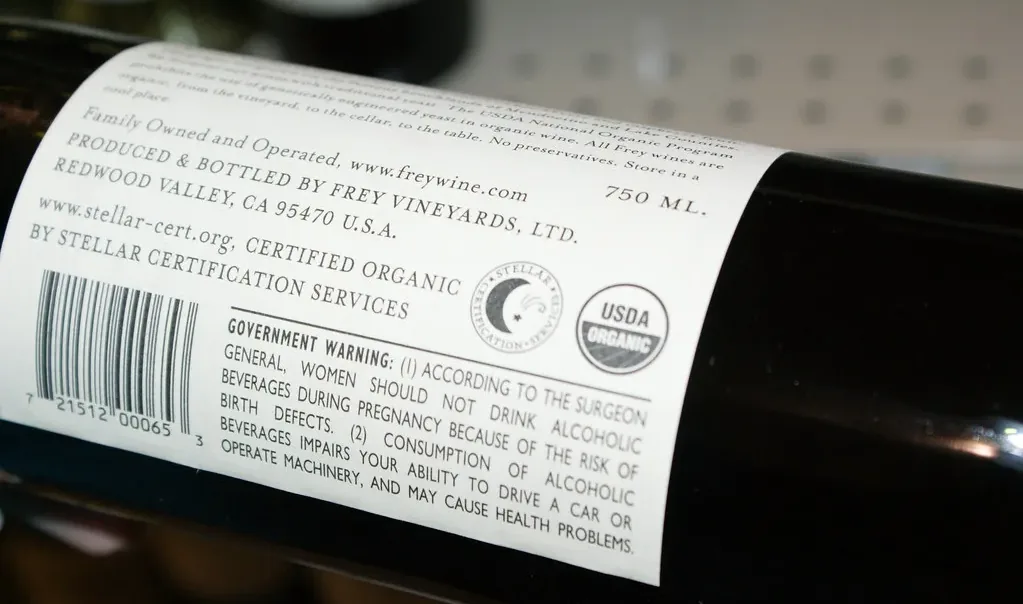
Organic is the one term with a genuine legal definition and mandatory third-party enforcement. In the United States it's governed by the USDA National Organic Program; in the European Union by regulations prohibiting synthetic pesticides, herbicides and synthetic fertilisers in the vineyard. To use the word, a producer submits to a multi-year transition period and annual independent audits, and can lose the certification.
One nuance catches even careful buyers. There's a difference between "organic wine" and wine "made with organically grown grapes." The first certifies the farming and the cellar. The second certifies only the fruit and allows more latitude in how the wine was actually made. France’s AB label originally applied to grapes alone; the EU’s 2012 extension to cellar practices means a modern vin biologique label now signals both.
By the numbers
most organic labels
from vineyard to cellar
certifying the word “natural”
Biodynamic: organic, and then a good deal more
Every biodynamic vineyard is already farming organically by definition, and then goes further: the whole estate treated as one system, composting on site, animals integrated, land set aside for biodiversity, and a specific set of preparations applied on a documented schedule.
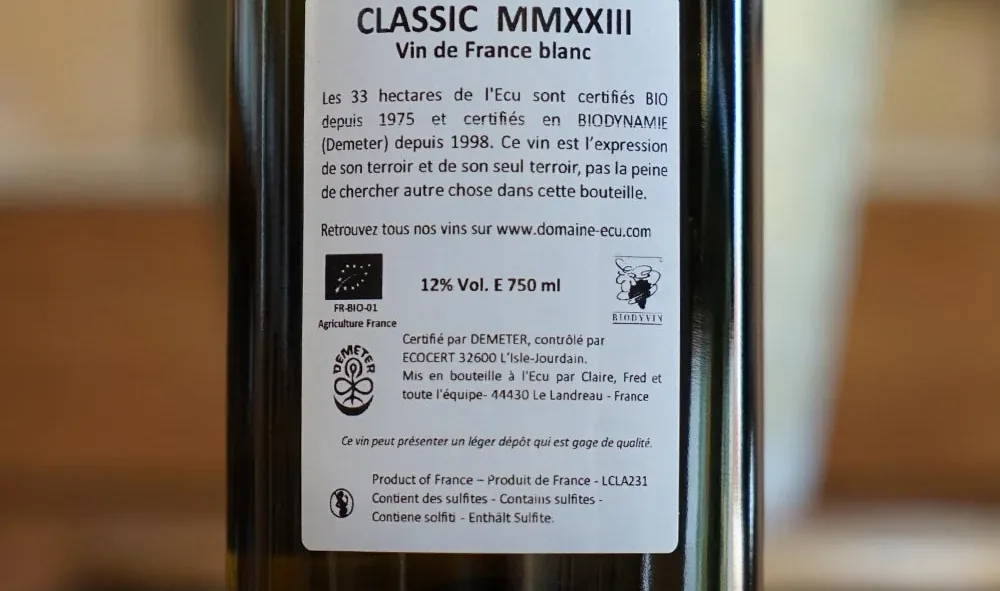
The credible certifications are Demeter, the international standard, in place since 1928, older than most organic labels by half a century. And Biodyvin, a wine-specific body founded by around fifteen French producers in 1995. Both require the entire estate to be certified rather than a convenient block, and both audit annually. A Demeter mark is one of the strongest farming guarantees available to a wine drinker.
Worth being equally clear about what biodynamic certification is not: farming and quality are separate questions, and conflating them does nobody any favours — which brings us to the reputation the term has been carrying around for decades.
Biodynamic certification tells you how the grapes were grown. It says nothing about whether the wine is good. Both questions matter; they're not the same question.
Natural and sustainable: the words with no referee
Here the ground gets soft, and it's worth being precise rather than dismissive.
Natural wine has no legally binding definition anywhere in the world. It generally describes wines made with wild-yeast fermentation, little or no added sulfur and minimal filtration, and for most of the world no body certifies it, so the word describes an intention rather than an audited practice. France is the exception: since 2020 the Syndicat de Défense des Vins Méthode Nature has run a charter — hand harvest, wild yeasts, no additives, and either no added sulphur or a declared 30mg/l ceiling — with its own logo, obtained in negotiation with the DGCCRF. It is a private standard rather than an appellation, so it binds only the growers who sign it. Some of the most thrilling wines being made today are natural wines. So are some faulty ones, and honest producers in the category will say so themselves.
Sustainable is softer still: no body certifies it, so a wine farmed with synthetic chemicals can lawfully carry the claim. That word has grown big enough to need a piece of its own — including what it costs the growers who took the harder road.
The reputation that is decades out of date
For a long time, organic or biodynamic on a label carried an unspoken warning: well-meaning, but probably a compromise. That reputation had real roots — early organic wines, particularly those made with little stabilising sulfur, could be inconsistent, and people who tried them in the eighties and nineties were not imagining things.
It is simply very out of date, and the clearest way to see that is to look at who farms this way quietly, without making it their marketing.
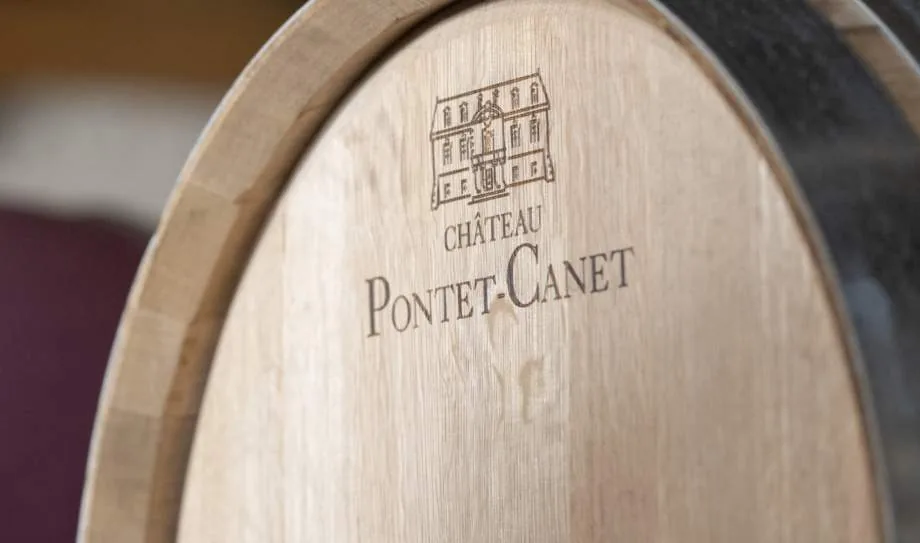
Château Pontet-Canet, a Fifth Growth in Pauillac, was the first Médoc classified growth to convert fully — organic and biodynamic certification for the 2010 vintage, Demeter in 2014 — and is now regarded as a reference producer of the Left Bank. Domaine Leflaive, the benchmark address for white Burgundy, converted all its vineyards by 1997 under Anne-Claude Leflaive, a founding member of Biodyvin. Domaine de la Romanée-Conti, maker of the most coveted red wine on earth, farmed organically from the mid-1980s, converted the whole domaine to biodynamics by 2007 and took Biodyvin certification in 2017.
And it is not confined to the auction room. M. Chapoutier holds Demeter certification across properties including Hermitage, and applies the same farming to widely available regional wines at ordinary prices. Bonterra has farmed organically in Mendocino since 1987, holds Demeter certification on ranches including McNab and Butler, and sits on grocery-store shelves at everyday prices with single-vineyard reds drawing scores above ninety points.
The most coveted red wine on earth is farmed this way. So is a bottle by the supermarket checkout.
What a mark actually certifies
You don't need to remember any of the above at a shelf. Look for a mark rather than an adjective — which word is which, and what the difference costs the people farming carefully, is the subject of its own piece.
Then ask the question this piece has been answering: what exactly does that mark certify — the fruit, the cellar, or the entire estate? Those are three different promises, they are all printed, and once you know to look the aisle is a great deal easier to read.
A mark means somebody checked. What they checked — the fruit, the cellar, the whole estate — is the part worth ten seconds more.
The receipt
What to take from this
- Organic has a legal definition, a multi-year transition and annual independent audits — and can be revoked.
- "Organic wine" covers farming and cellar. Wine "made with organically grown grapes" covers only the fruit.
- Biodynamic is organic plus whole-estate requirements, audited annually by Demeter (since 1928) or Biodyvin (since 1995).
- Sustainable has no certifying body. Natural has one — France’s Vin Méthode Nature, since 2020 — but it is a private charter, not an appellation, and it binds only its signatories.
- The old "biodynamic means mediocre" reputation is decades out of date: DRC, Leflaive and Pontet-Canet all farm this way.
- It's not only for the auction room — Chapoutier and Bonterra apply the same farming at everyday prices.
Where the claims come from8
-
Syndicat de Défense des Vins Méthode Nature — the charter and certification procedure
vinmethodenature.org ↗ -
Demeter USA — Biodynamic Certification standard
demeter-usa.org ↗ -
Jancis Robinson — Biodyvin’s biodynamic wines
jancisrobinson.com ↗ -
Biodyvin certification — history and standard
winewithseth.com ↗ -
French Wine Authority — Biodynamic and organic winemaking in France
frenchwineauthority.com ↗ -
Decanter — Pontet-Canet, ten years of biodynamics
decanter.com ↗ -
Bonterra Organic Estates — Biodynamic farming and Demeter ranches
bonterra.com ↗ -
SevenFifty Daily — the origin story of biodynamic wine
daily.sevenfifty.com ↗