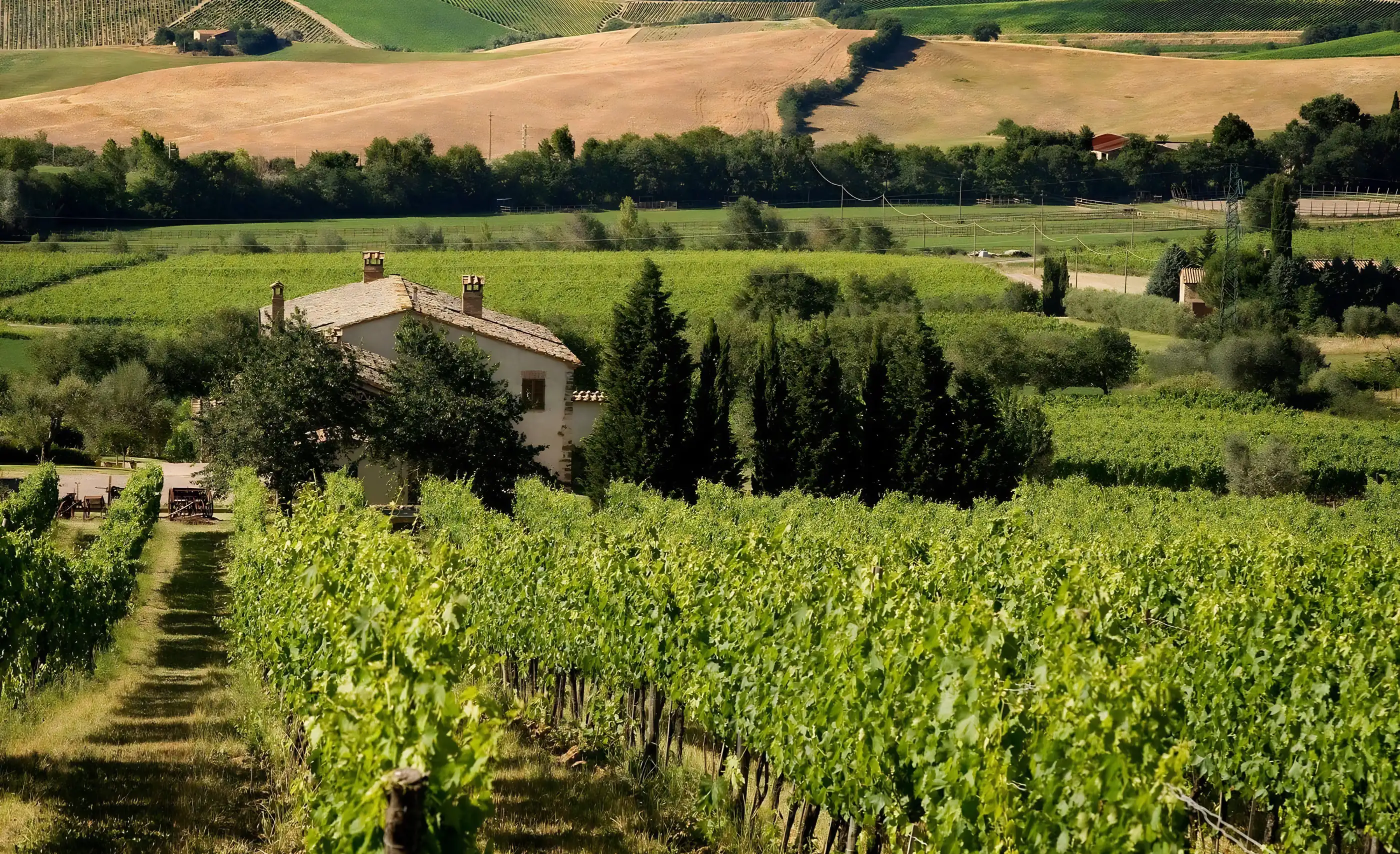
Fattoria La Vialla
The Free Bacchus Story
About ten years after buying a run-down house near Arezzo, Piero Lo Franco, a textile businessman, called his three sons together. He wanted to change his job and go into the fields, he told them. Would they join him? They were 20, 18 and 13. Piero and his wife Giuliana had bought the house in 1978 so the boys could be close to nature in the holidays, and then kept buying the small farms the end of Tuscan sharecropping had left empty. The sons said yes, and Gianni, Antonio and Bandino still run La Vialla together.
Nobody in Italy wanted organic wine then, and Piero’s attempts to sell it at home got nowhere. But the family had opened the restored farmhouses to holiday guests, mostly from northern Europe, and the Germans among them wanted the wine and cheese back home. So Gianni, who had held a driving licence for a month, and Antonio hitched a trailer to a battered Renault Espace and drove the orders to Munich and Stuttgart themselves. That became the business. By 2017, when the writer Andrew Jefford visited, La Vialla had 10,000 direct-delivery customers in Germany alone.
Chianti is Tuscany’s great Sangiovese name, and the Colli Aretini, the hills around Arezzo, is one of its seven subzones. Sangiovese makes reds of cherry and plum with fresh acidity and a firm grip, lighter than the Brunello of Montalcino, and La Vialla’s vineyards near Arezzo climb the slopes of the Pratomagno to 650 metres, higher than most in Chianti. The family’s signature, though, is Vin Santo, Tuscany’s traditional dessert wine. White grapes, mostly Trebbiano and Malvasia, are laid on mats or hung up to dry for three to six months, then pressed and sealed in small barrels called caratelli for at least three years, four for a Riserva. What comes out is gold to amber and sweet, with dried apricot, fig and honey, and in Tuscany it is the wine of hospitality.
The farm is mixed, and big: by the family’s count, 23 farmsteads, 185 hectares of vines, more than 31,000 olive trees and 1,302 Sardinian sheep for pecorino. Grandmother Caterina had always farmed with manure and by the lunar calendar, so organic came by instinct; the family dates its organic certificate to 1983 and Demeter to 2005. Today the EU organic register lists the whole company under ICEA, farm and winery, and every wine is certified organic, or ‘in conversion’ where it comes from newly added land. The Demeter mark goes on bottle by bottle, and the family’s goal of putting it on every label is not met yet. The Vin Santo Riserva carries it; the 2021 Casal Duro carries only the EU organic leaf.
Casal Duro is the top red, Cabernet Sauvignon and Merlot from a vineyard planted in 2000 on the re-terraced ground of an old vegetable patch. The family calls it a Super Tuscan, the name for Tuscan reds made outside the Chianti rules, and waited seven years before the first harvest for it. The Vin Santo del Chianti Riserva 2018, four years in caratelli and Demeter on the label, won Platinum at the 2026 Decanter World Wine Awards.
“We were very serious and a little bit worried.”
Why it’s remarkable
Free Bacchus Verification
ICEA EU organic · Demeter Italy on many wines, not all
Certified2
- EU organic (ICEA, IT-BIO-006.380-0009483): the whole company, farm and winery; every wine is certified organic (or ‘in conversion’ from newly added land)
- Demeter (Demeter Italy, IT-IT-BIO-006-B125, to April 2027): many wines, not all, also carry the Demeter mark
If you’re buying
Cheat sheet
Save it to your phone. Everything you need to recognise this producer, and three things worth saying about it, at a glance in a shop or across a table.