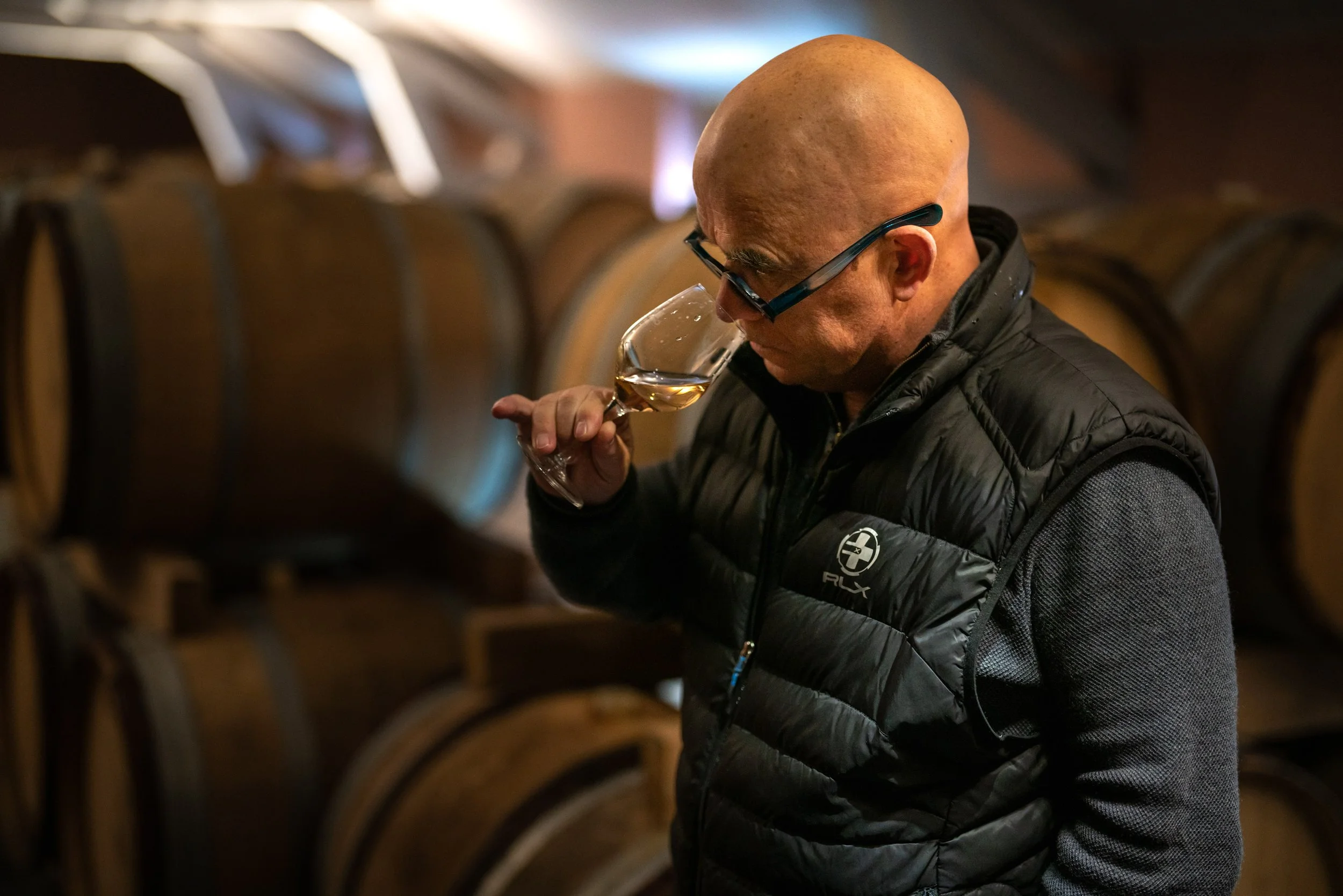
Eric Rodez
The Free Bacchus Story
Eric Rodez came home to Ambonnay in September 1982 thinking he knew everything. He had spent 1975 to 1978 in Beaune, studied oenology at the University of Reims and trained at Krug under Henri Krug, and in November 1983 he took over his mother’s family estate. His first wines, by his own account, had no emotion in them at all. After the poor 1984 vintage it took him four years to find another way, and he went looking for it outside Champagne, above all in Alsace, where in the 1980s he met Jean-Michel Deiss of Domaine Marcel Deiss.
Ambonnay is one of the seventeen villages that keep Champagne’s old grand cru rank, on the southern slopes of the Montagne de Reims, where Pinot Noir is the main grape. Pinot Noir is the black grape that gives Champagne its body and structure and a scent of red fruit; Chardonnay, the star of the chalk of the Côte des Blancs, brings freshness and citrus. Champagne is made twice, once as a thin, sharp base wine and again in the bottle, which is where the bubble comes from, and most of it is a blend. A non-vintage bottle leans on reserve wines, still wines kept back from earlier harvests so the style holds from year to year, and by Eric’s reckoning a typical one is about 70% new harvest and 30% reserve. Rodez turns that round. Cuvée des Crayères, the entry blend and, he says, the hardest to make, is about 70% reserve wine, and since the labels changed around the start of 2024 every blend carries its edition number, the year it went into bottle, counted from Edition 1 in 1985. At the very end a little sugar goes in. Extra Brut, which is what these labels say, allows no more than six grams a litre, and the current Grands Vintages takes one and a half.
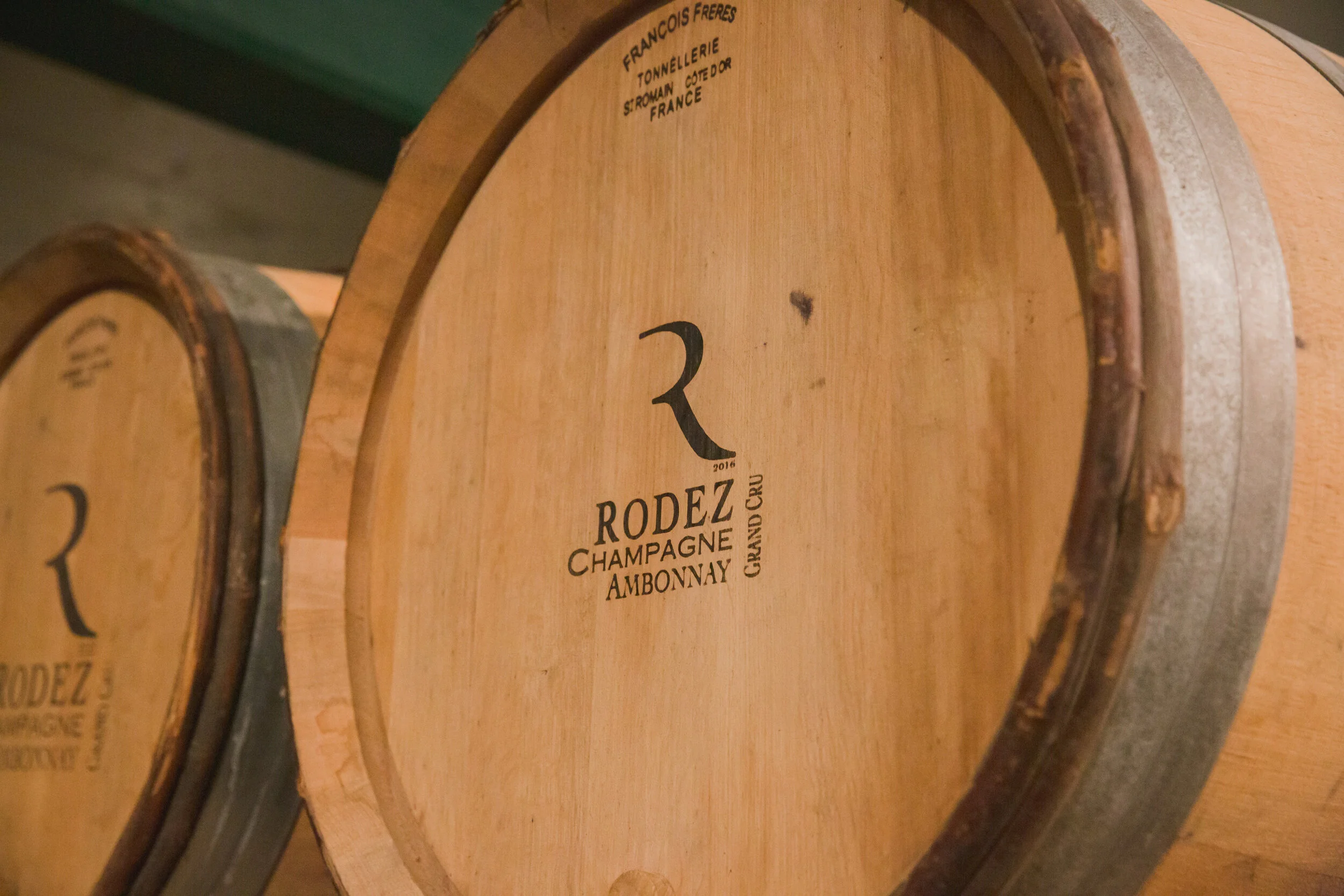
Around eight per cent of Champagne’s vineyard is organic or converting even now; the Rodez family began changing theirs in 1989, bringing the soil back to life and giving up weedkillers step by step. In the spring of 1995, seeing the vines grow differently, they started learning organic methods, and biodynamic practice followed in the mid-2000s. In 2007, regretting how little the region as a whole was moving, they decided to convert formally, and Ecocert took the estate on in April 2009. After the three-year conversion every vineyard has to serve, the wines count as organic from the 2012 harvest; Demeter, which the family dates to 2015, is current to June 2027. Neither covers everything. Part of the vineyard is still in conversion, so not every parcel is yet certified organic, and Demeter France lists named wines rather than the whole range: the blends made only from the 2015 and later harvests, some single-parcel Champagnes by vintage, and the still wines.
Eric also ran the village. He sat on Ambonnay’s council from 1989 and was its mayor from 2001 until he stood down in 2020, and in 2016 he was elected unanimously as president of the Villa Bissinger, Champagne’s international wine institute. The family has worked vines in Ambonnay since 1757, and the ninth generation, his son Mickaël, now leads the estate under his father’s watchful eye. It was Mickaël who, from the early 2000s, took the family into single-parcel wines. Since 2014 he and Aurélie have set aside areas for biodiversity and made essential oils standard in the vines, and they are bringing back Arbane and Petit Meslier, two old Champagne grapes, to hold on to freshness as the climate warms.
Grands Vintages sits at the top of the blends, made, the family says, only from its best years. It is 70% Pinot Noir and 30% Chardonnay, fermented entirely in oak and, where possible, blended only from wines that skipped malolactic fermentation, the natural process that turns malic acid into lactic acid. The current release, Edition 36, went into bottle in the spring of 2020 and came out in 2026. Eric himself calls the Blanc de Noirs, a white Champagne made only from Pinot Noir, the estate’s signature, and it was the Champagne on the wine list at the 2025 Nobel Prize banquet.
“I had to convince my family, and continue to sleep at night!”
Why it’s remarkable
Free Bacchus Verification
Ecocert EU organic · Demeter France, named wines
Certified2
- EU organic (Ecocert, FR-BIO-01.250-0074122), engaged April 2009 and organic from the 2012 harvest
- Demeter (Demeter France, FR-FR-BIO-01-69005, to June 2027): Demeter France lists named wines (the blends of the 2015 and later harvests, some single-parcel Champagnes and the still wines), not the whole range
Also on record1
- Part of the vineyard is still in conversion, so not every parcel is yet certified organic
If you’re buying
Cheat sheet
Save it to your phone. Everything you need to recognise this producer, and three things worth saying about it, at a glance in a shop or across a table.