Domaine Dugat-Py
The Free Bacchus Story
The Chambertin at Domaine Dugat-Py comes from five ares of vines, a twentieth of a hectare near the top of the slope, planted in 1910. It makes 220 to 270 bottles a year. 2016 was a hard year. Frost caught the bottom of the Gevrey slope, so there was no Cuvée Halinard at all, and two cuvées had to be grouped together to make the minimum to sell. The Chambertin that year filled half a barrel. Loïc Dugat-Py, the owner and winemaker, kept the domaine organic through it, and he said it took a lot of work by hand.
Loïc is the thirteenth generation of his family to work the vines of Gevrey-Chambertin, where the family traces its winegrowing to the start of the seventeenth century. Before the family bottled its own wine, Maison Leroy had long been a client. His father, Bernard, made his first vintage in 1975 and married Jocelyne Py in 1979. In 1994 Bernard separated his vines from his cousin’s and named the domaine Dugat-Py, adding Jocelyne’s maiden name to his own. Loïc joined two years later. His parents went looking for well-placed parcels of old vines, and in the late 1990s Bernard bought the Chambertin from the Dupont family. The vines are the domaine’s strong point, Loïc says, because his great-grandfather was a nurseryman, and across the domaine they average 65 years old.
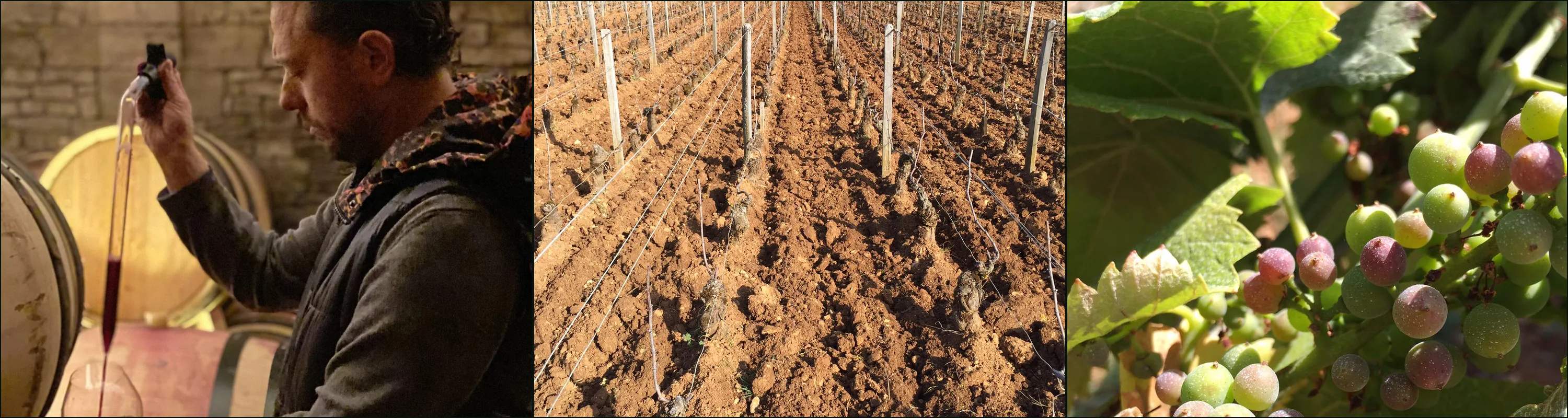
Red Burgundy is Pinot Noir, grown along the Côte d’Or, a slope about fifty kilometres long cut into named plots called climats, and Gevrey-Chambertin lies in its northern stretch, the Côte de Nuits. The labels rank the land in four steps: regional Bourgogne, then a village name, then premier cru, a named climat within a village, and at the top the grands crus, where the village name drops off the label and the climat stands alone. Dugat-Py bottles at every step, mostly red with a little white from Chardonnay. Its largest cuvée is a village wine, the Gevrey-Chambertin Coeur de Roy, from almost three hectares of old vines. At the top, the domaine has four grands crus in Gevrey alone. Two of them, Charmes-Chambertin and Mazoyères-Chambertin, lie side by side, and the rules let Mazoyères be sold as Charmes but not the other way round, so very little is ever labelled Mazoyères. Dugat-Py is one of the few growers to bottle both, because, Loïc says, the soils differ. There is more sand in Charmes, which makes a rounder wine that can be drunk young, while Mazoyères has more power. For years the domaine had a name for deeply coloured, tannic wines. Tasting through the range in 2025, Decanter’s Burgundy correspondent, Charles Curtis MW, found wines of great sensitivity and elegance, and the domaine suggests at least six to eight years in bottle before its wines show what they are.
Loïc has changed the work in the vineyard for a warmer climate. Horses have ploughed the Chambertin, the Mazis-Chambertin, the Fonteny premier cru and Les Evocelles since 2006. In the premier and grand cru parcels the long shoots at the top of the vines are braided together instead of being cut back, the trellis has gone up to 2.2 metres, and in 2020 picking began on 20 August, among the first in the region, to keep the wine fresh. “I feel that chemicals tend to even out the differences between the wines,” Loïc told Ola Bergman in 2016. With organic farming, he said, each vineyard shows its character more clearly.
The organic work began in 1999 in the Chambertin and the Coeur de Roy vines, and in 2003 the whole domaine went organic. The certificate came much later. Certification, Loïc told the Burgundy Report in 2017, had not been a priority before. The domaine signed on with the certifier Bureau Veritas in February 2012, and after the three-year conversion a vineyard has to serve, its certificate lists wine from the 2015 vintage on. Its American importer dates certification to 2003, the year the farming changed; the register’s first date is 2012. Two companies share the address on the Rue de Planteligone, and both hold Bureau Veritas certificates. SAS Dugat-Py’s certificate names red, white and rosé from 2015 to 2025. SARL Dugat-Py, which Loïc runs, signed on in July 2020, and its wine is certified from the 2025 vintage only. The certificates name colours and vintages, not cuvées, and both companies still farm some land in conversion. Wines made before 2015 are outside the certificate, and the domaine is not certified biodynamic.
“To be honest it was hard to stay Bio in 2016”
Why it’s remarkable
Free Bacchus Verification
Bureau Veritas EU organic · wine certified from the 2015 vintage
Certified3
- EU organic, Bureau Veritas Certification France (FR-BIO-10): two companies at one address in Gevrey-Chambertin
- SAS Dugat-Py (FR-BIO-10.250-0010382, to March 2028; engaged February 2012), wine certified from the 2015 vintage
- SARL Dugat-Py (FR-BIO-10.250-0078391, to March 2028; engaged July 2020), wine certified from the 2025 vintage only
Not covered1
- Wines before 2015
Also on record3
- Both companies still have vineyard land in conversion
- The certificates name colours and vintages, not cuvées
- Not biodynamic
If you’re buying
Cheat sheet
Save it to your phone. Everything you need to recognise this producer, and three things worth saying about it, at a glance in a shop or across a table.