De Toren
The Free Bacchus Story
In 2017, the first year of De Toren’s conversion to organic farming, drought cut its water allowance to enough for 9 of its 22 hectares of vines. Charles Williams, then the winemaker, planned to stretch it over every vine anyway: three rounds of irrigation in the six-month growing season, on still evenings so less would evaporate, with bark over the soil to keep in what moisture there was. The conversion had also taken away the sprays the vines were used to. Since 2017, the estate says, no pesticide or herbicide has been used on the farm. Its example is mealybug, the insect that spreads a virus through the vines; the spray used against it also killed the insects that prey on it. By early 2018 the estate was seeing more ladybirds and lacewings in the rows, and falcons, eagles and owls keep down the vermin.
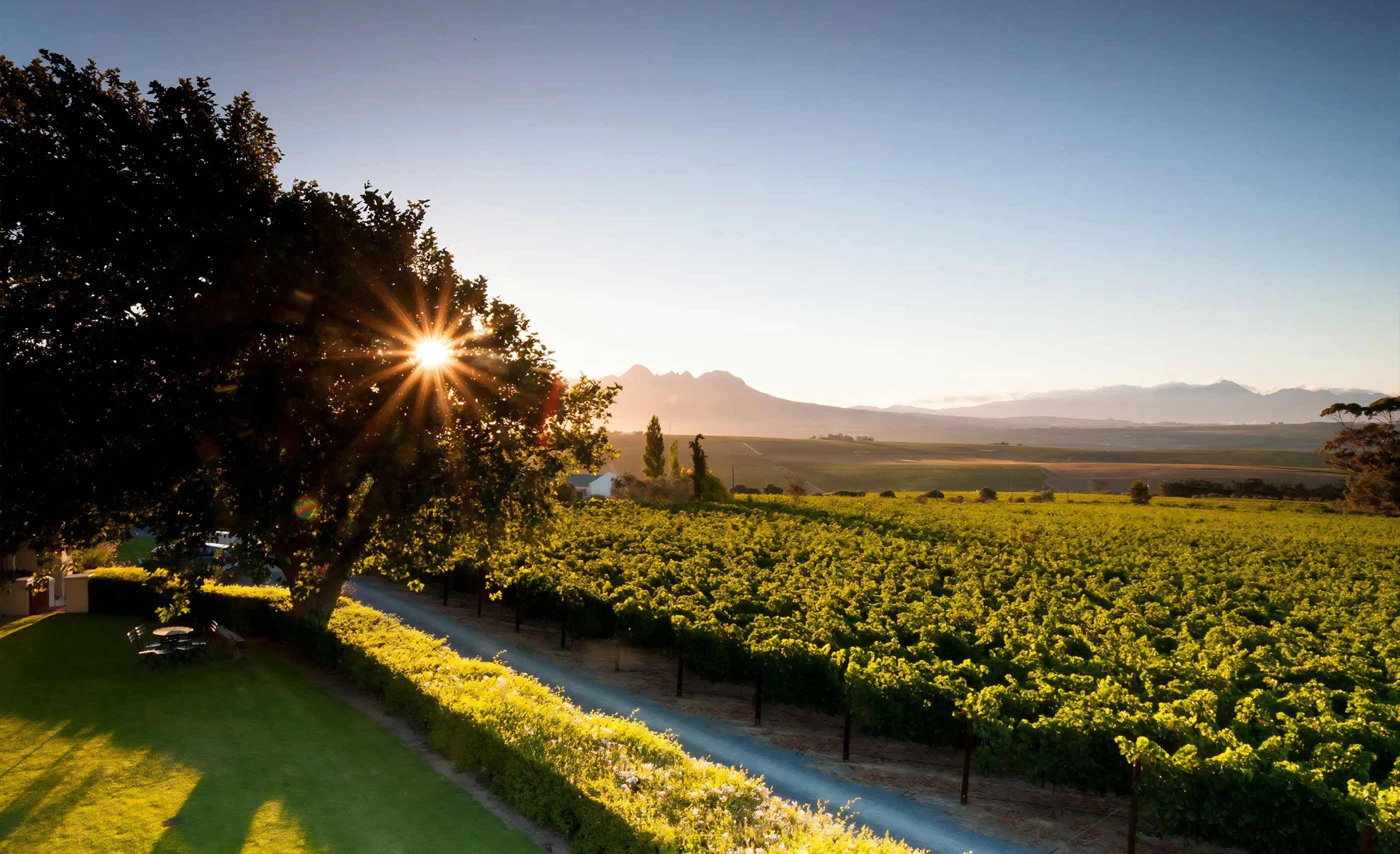
Emil and Sonette den Dulk bought the farm, on the Polkadraai Hills in Stellenbosch, in 1991, for its view from the Helderberg over False Bay to Table Mountain, and meant it as a home. When wine took over, the estate and academics from Stellenbosch University dug a dozen soil sampling holes to the hectare, three times the industry’s norm, and found 15 soil types in 25 hectares, mostly decomposed granite, from rock the estate dates back 540 million years, over clay. The rows were turned into the summer wind off False Bay, instead of running north–south or east–west, so the sea air blows through the vines and cools them. De Toren is Dutch for ‘the tower’, after the one over its gravity-fed cellar. Albie Koch came as the first winemaker at 22 and made the first Fusion V, from the 1999 vintage. In 2018 Emil den Dulk sold to Swiss shareholders; Koch kept his share and still runs the estate, with Charles Williams as cellar master and Martin Fourie as winemaker, both since 2019.
Stellenbosch is judged above all on Cabernet Sauvignon and on Bordeaux-style blends, and those are what De Toren was built to make. In Bordeaux itself, the gravel of the left bank grows Cabernet Sauvignon, which gives blackcurrant fruit and a firm, drying grip, and the clay of the right bank grows Merlot, rounder and softer, with plum fruit. De Toren made a wine for each. Fusion V is the left-bank one, led by Cabernet from the warmer, gravelly blocks; Edition Z, first made as Z in 2004, leads with Merlot from clay-rich blocks that face the sea. Fusion V is named for all five of Bordeaux’s classic red grapes: besides Cabernet Sauvignon and Merlot, the estate uses Cabernet Franc for a floral lift, Malbec for colour and sweet spice, and a little Petit Verdot for tannin and colour. Tim James of Winemag has pointed out that Bordeaux in fact recognises a sixth red grape, Carménère. The Délicate is the light one, mostly Malbec and meant to be served chilled, and Patronus is a straight Malbec from decades-old vines. In 2015 Christian Eedes of Winemag wrote that De Toren ‘makes no apologies’ for super-ripe, luxurious wines. Tim Atkin MW gave Fusion V 2021, the first certified vintage, 96 points in his 2024 South Africa report and called it one of the best releases yet, ‘reflecting the cooler vintage as well as the move to earlier picking’.
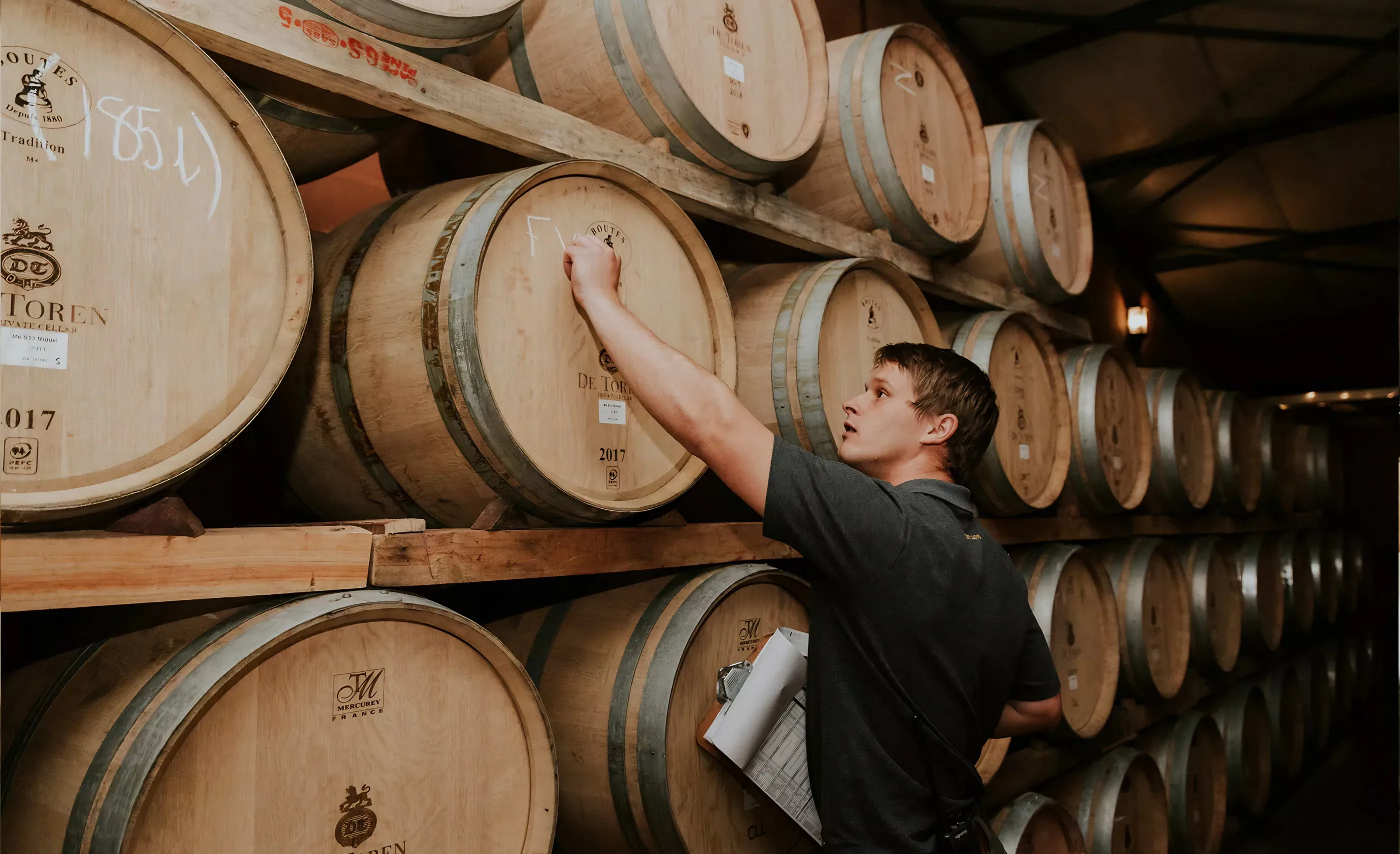
In 2008 the team set itself a question. With no limits on the vineyard, the cellar or the cost, how would it make the best wine in the world? Book XVII, born in 2010, was the answer, named after the seventeenth book of Pliny the Elder’s Natural History. In 2016 the estate described fermenting it inside new French oak barrels, turned every two hours to keep the juice on the skins. Book XVII 2023 is 60 per cent Cabernet Sauvignon with Cabernet Franc and Malbec, five barrels and 1,397 bottles of it, each in a wooden box that opens with a key. Jamie Goode, writing for Winemag in 2025, named Book XVII among South Africa’s icon wines, priced high from the start and ‘almost comically’ caged. In September 2026 Tim Atkin MW, who wrote that Book XVII had often seemed more style and marketing than substance, scored the 2023 97 points and said it ‘lives up to the hype’.
The conversion ran from 2017 to 2019. In its last season weekly cold fronts brought the wet weather downy mildew needs, and Williams wrote that the team watched the weather around the clock. By the estate’s own dated account its grapes were certified organic in July 2020, after that year’s harvest, so 2021 is the first certified vintage; Ecocert, which certifies them today, publishes nothing for De Toren before July 2025. What is certified is the grapes, not the wine, so no De Toren wine is certified organic, and the certificate records some non-organic production alongside. This page covers the five estate wines, Délicate, Edition Z, Fusion V, Book XVII and Patronus, from the 2021 to the 2024 vintage; they are made from certified organic grapes, although some vines are still in conversion. The 2025 wines are not covered, because from July 2025 to February 2026 the certificate also listed a Cabernet Sauvignon parcel still in conversion and does not say which wines that fruit went into. Merlot came off the certificate in April 2026, so the 2026 Fusion V, Edition Z and Délicate may not be covered. The Black Lion, a Shiraz from grapes the estate says it sources in the Swartland, Stellenbosch and the Helderberg, is not covered, since Shiraz is on no version of the certificate. Nor are the Uncharted Collection, whose grapes the estate does not name, or vintages before 2021, such as the Edition Z 2020 the estate still sells. De Toren holds no US organic certificate.
“Organic farming, especially during the transition phase has very limited margin for errors.”
Why it’s remarkable
Free Bacchus Verification
Ecocert EU organic grapes · estate wines 2021–2024
Certified2
- EU organic, Ecocert SAS (ZA-BIO-154), grapes only, held by Kleine Uitzicht Wines t/a De Toren (ZA-BIO-154.710-0000392.2026.005, valid to 31 March 2028)
- The estate dates its certification to July 2020, before the register’s first published version of July 2025
This page covers
The five estate wines (Délicate, Edition Z, Fusion V, Book XVII and Patronus) from the 2021 to the 2024 vintage, made from certified organic grapes
Not covered3
- The 2025 wines, because from July 2025 to February 2026 the certificate also listed a Cabernet Sauvignon parcel still in conversion and does not say which wines that fruit went into
- The 2026 Fusion V, Edition Z and Délicate may not be covered: Merlot left the certificate in April 2026
- The Black Lion (Shiraz, on no version of the certificate), the Uncharted Collection and every vintage before 2021
Also on record2
- The certificate covers the grapes (Cabernet Sauvignon, Cabernet Franc, Malbec and Petit Verdot, with some Malbec still in conversion and non-organic production recorded alongside), not the wine, so no De Toren wine is certified organic
- No US organic certificate
If you’re buying
Cheat sheet
Save it to your phone. Everything you need to recognise this producer, and three things worth saying about it, at a glance in a shop or across a table.