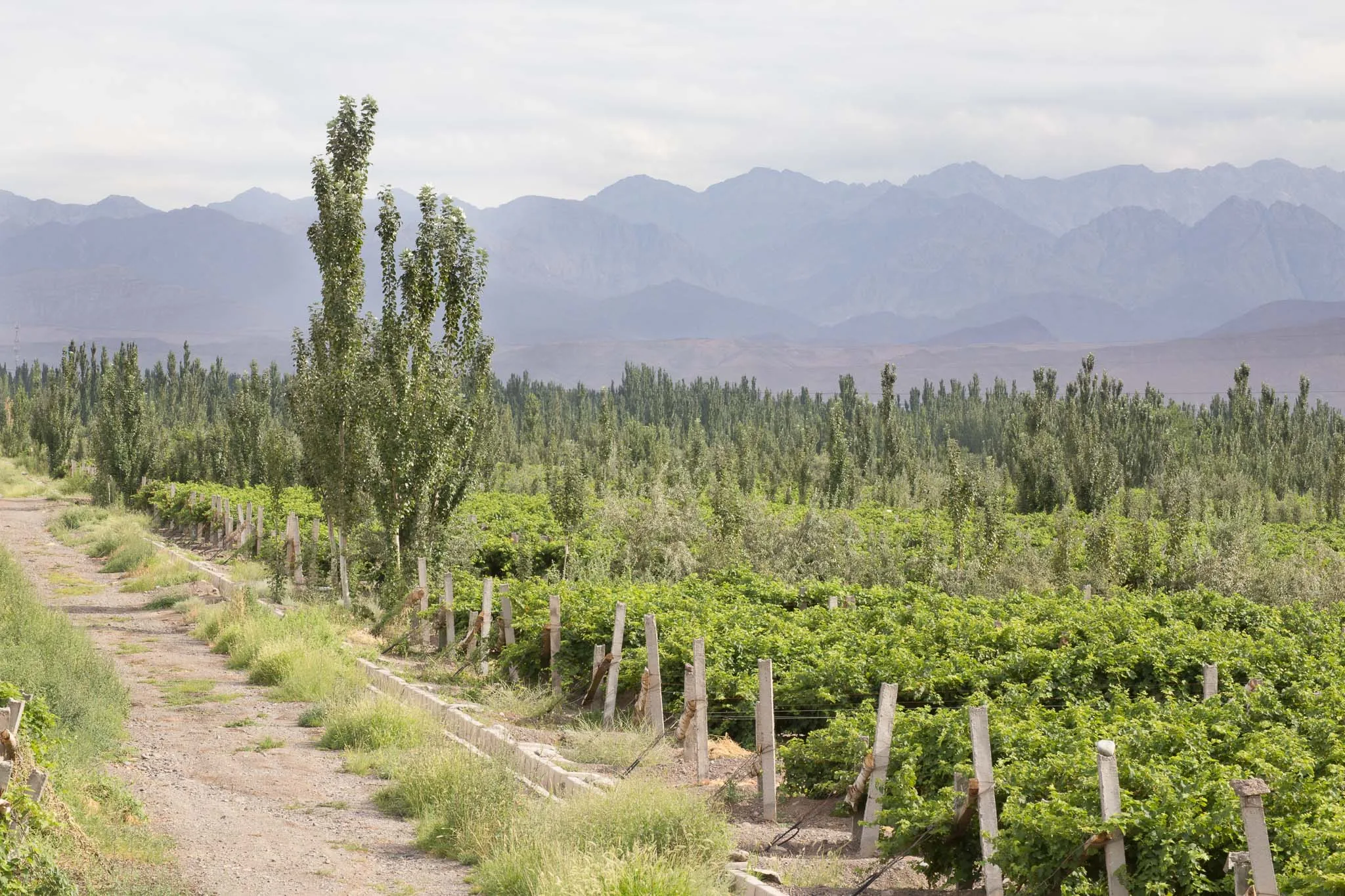
Puchang Vineyard
The Free Bacchus Story
On 3 April 2024 Puchang Vineyard, a wine estate in the Turpan basin of Xinjiang in north-west China, sent a sealed notice to its agents and distributors. Any bottle that lacked China’s organic anti-counterfeit label was to be returned or exchanged before 7 April. A seller who could not manage that in time had to replace the label, or cover the organic mark and the certifier’s mark, and sell the wine as conventional. If a regulator or a shopper bought such a bottle, the company wrote, it would count it as conventional too. The notice is still on the estate’s own website.
The vines are older than the name. A local winery planted the estate in 1975, and in 2008 K.K. Cheung, an entrepreneur from Hong Kong, bought it, renamed it Puchang Vineyard and set about restructuring the vineyard; the first Puchang vintage was 2009. By the estate’s account, a bottle of Puchang wine had shown Cheung what winemaking in Xinjiang could do. His daughter, Clara Wang, told JamesSuckling.com in 2020 that because the estate lies on the Silk Road it also planted the ancient Georgian grapes Saperavi and Rkatsiteli, ‘which turned out to be a success’. The chief winemaker is Loris Tartaglia, an Italian who began making wine in 2004 and has worked from the United States to New Zealand, South America and South Africa.
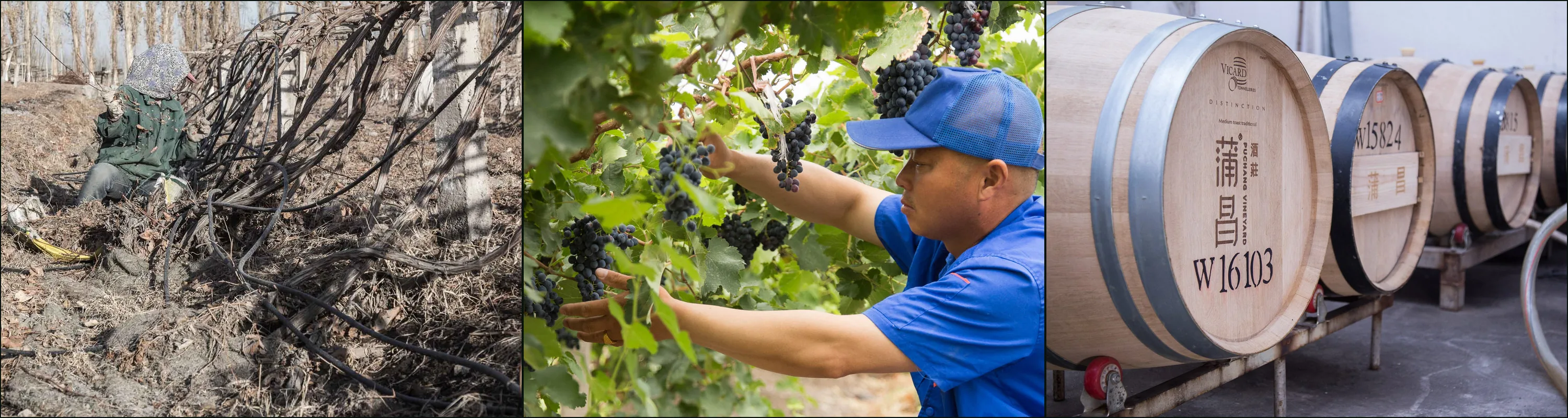
Most readers will never have tasted a Chinese wine, and Turpan is an extreme place to start. Cheung describes it as the hottest spot in China, a depression 154 metres below sea level, though Puchang’s vines grow hundreds of metres higher. The estate records 16 to 20 millimetres of rain a year. Its water is snowmelt from the Tian Shan mountains, brought in through karez, old underground channels that lose less of it to evaporation. Winter swings the other way, to minus 20°C, and Tartaglia’s team buries the vines by hand against the cold, as Turpan’s growers have for centuries; only the Beichun, a hybrid bred in the 1950s for Xinjiang’s climate, stays above ground. Heat ripens grapes fast. A hot, dry climate, Tartaglia explains, gives more sugar and aroma and less acidity, and he describes Puchang’s wines as rich, fruity and full-bodied. The estate’s two signature grapes, both from Georgia, are naturally high in acid. Saperavi, a red that reached China in 1957, has dark flesh as well as dark skin, so its wine comes out an intense violet. Rkatsiteli, a white that arrived a year earlier, is crisp, with apple and mineral notes in the estate’s description.
The one wine Ecocert’s certificate names is the Rkatsiteli Orange. Orange wine is white wine made the way red is, left on its skins, which turns it amber and gives it some of a red’s grip, and the estate describes its own as deep amber, with ripe yellow fruit, citrus and firm tannin. JamesSuckling.com placed the Rkatsiteli Orange 2021, fermented wild with no added sulphites, 20th in its Top 100 Wines of China for 2023, and the Rkatsiteli Orange 2022 sixth a year later. Tartaglia fermented the 2022 on its lees for more than a month and then aged it for two years in 2,000-litre casks, big vessels that the site notes are unusual in China.
Ecocert, the French certifier, certifies Puchang’s wine to the EU organic standard, on a certificate valid from 1 August 2025 to 31 March 2027. It lists three wines as organic: ‘Dry White Wine’, ‘Dry Red Wine’ and ‘Rkatsiteli Orange’. The first two are not cuvées but the wine-type classes Puchang’s labels print after each wine’s name, and the certificate records non-organic wine made alongside the organic, so it does not say which of Puchang’s dry reds and whites, the Viaseres among them, are the organic ones. The sweet wines and the rosé are not among the types it lists. The estate says Ecocert first certified it in 2013, after five years of inspection, and that it is inspected and re-certified every year; Ecocert’s register serves nothing for Puchang from before August 2025, so that start date is the estate’s word. Puchang is not certified biodynamic. Its Chinese organic certification, which the 2024 notice concerns, is a claim of the producer and the press, not a register read, because China’s national register cannot be searched without a captcha.
“Since most diseases develop with humidity, any chemical treatment is unnecessary.”
Why it’s remarkable
Free Bacchus Verification
Ecocert EU organic · wine only, with non-organic wine made alongside
Certified2
- EU organic, Ecocert SAS (CN-BIO-154), wine only, held by 吐鲁番蒲昌葡萄酒业有限公司 (Turpan Valley Puchang Wine Trading Ltd. on Ecocert’s directory), Gaochang District, Turpan (CN-BIO-154.156-0003815.2026.004, reissued 3 September 2026), valid 1 August 2025 to 31 March 2027
- The estate dates its Ecocert certification to 2013, before the register’s first published document of August 2025
This page covers
The wines the certificate lists as Organic: ‘Dry White Wine’, ‘Dry Red Wine’ and ‘Rkatsiteli Orange’, the one cuvée it names
Not covered1
- The sweet wines (The Clovine, Sweet Beichun) and the Rose Beichun, which are not among the wine types the certificate lists
Also on record4
- ‘Dry Red Wine’ and ‘Dry White Wine’ are generic label classes, not named cuvées
- Non-organic wine is made alongside the organic, and the certificate does not say which of Puchang’s dry reds and whites, the Viaseres among them, are organic
- Not certified biodynamic
- China’s national organic certification is claimed by the producer and the press, not read on a register: China’s national register (CNCA) cannot be queried without a captcha
If you’re buying
Cheat sheet
Save it to your phone. Everything you need to recognise this producer, and three things worth saying about it, at a glance in a shop or across a table.
From the Journal
More Verified Houses · China
Photograph at the top of this page: Puchang Vineyard in summer, Turpan by Puchang Vineyard, © Turpan Puchang Wine Co., Ltd. (吐鲁番蒲昌酒业有限公司), all rights reserved, via Puchang Vineyard. Resized for this page.
Photograph across the middle of this page: Winter work in the vineyard, Puchang by Puchang Vineyard, © Turpan Puchang Wine Co., Ltd. (吐鲁番蒲昌酒业有限公司), all rights reserved, via Puchang Vineyard. Cropped and resized as one panel of a three-photograph strip for this page.
Photograph across the middle of this page: Picking black grapes at Puchang by Puchang Vineyard, © Turpan Puchang Wine Co., Ltd. (吐鲁番蒲昌酒业有限公司), all rights reserved, via Puchang Vineyard. Cropped and resized as one panel of a three-photograph strip for this page.
Photograph across the middle of this page: A Puchang Vineyard barrel by Puchang Vineyard, © Turpan Puchang Wine Co., Ltd. (吐鲁番蒲昌酒业有限公司), all rights reserved, via Puchang Vineyard. Cropped and resized as one panel of a three-photograph strip for this page.


