Stark-Condé
The Free Bacchus Story
Apartheid law forbade Hans Schroder’s marriage to Midori Maruyama, a fellow student he met at university in Japan, so for 30 years they lived in Tokyo. They raised three daughters there. In 1989, with the end of apartheid in sight and Nelson Mandela’s release close, they moved to Stellenbosch, where Hans had grown up, and bought Oude Nektar, a farm in the Jonkershoek Valley ten minutes’ drive from the centre of town, to grow grapes. Their eldest daughter, Marie, and her American husband, José Conde, followed them.
José had met Marie on his first night in Tokyo, where a Japanese client of the design studio he worked for had asked him to spend a year. He grew up in Independence, Missouri, the son of a Cuban who had emigrated to the United States, and he came to South Africa meaning to open a design studio in Cape Town. Two weeks in Stellenbosch changed his mind. He taught himself to make wine, tasting and talking with small winemakers rather than going back to school, and his first Cabernet, made with basic equipment from grapes his father-in-law grew, came to 2,400 bottles and won five stars in Platter’s guide. The name on the label joins the two families. Stark is for Hans’s mother, Franziska Stark, the first of the family to settle in Stellenbosch, and Condé is for José’s father. José still designs every label himself.
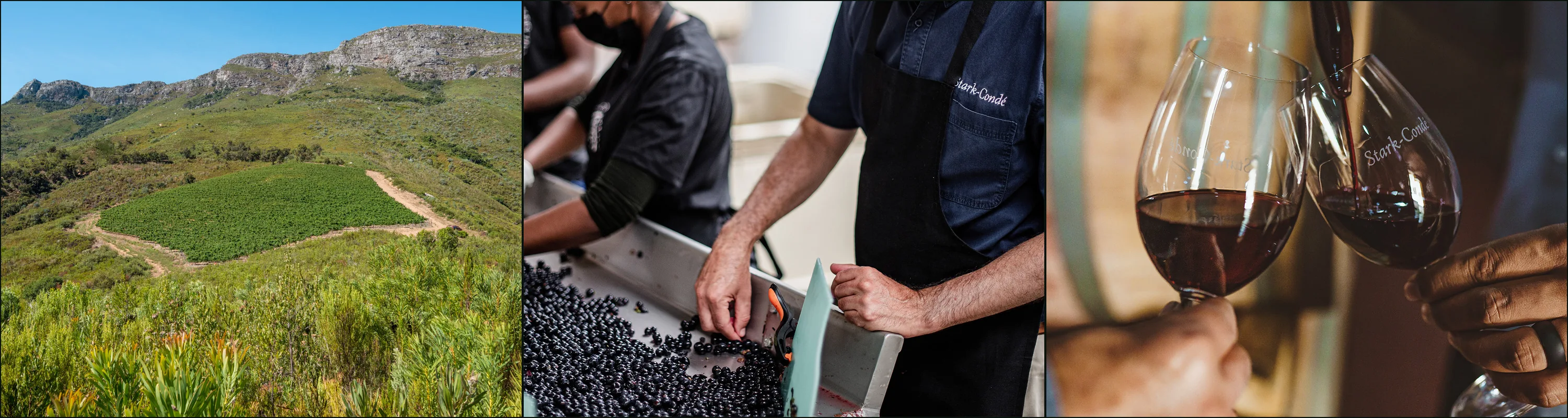
Stellenbosch is judged above all on Cabernet Sauvignon and on Bordeaux-style blends, which are Cabernet with smaller shares of the other red grapes of Bordeaux, and by José’s count Cabernet is about 60 per cent of what the estate makes. He says the Jonkershoek Valley is unlike the rest of Stellenbosch. The mountains around it hold in the rain clouds over winter, so it gets about twice the Stellenbosch average of winter rain, and its wines are known for an elegant tannin, the grip that dries the mouth after a sip of red. The estate makes its Cabernet at three levels: the Stellenbosch Cabernet, which it calls the bedrock of the winery; Three Pines, from a single vineyard at 350 metres, named for the three pines that stand above it; and Oude Nektar, a Bordeaux-style blend built around the highest vineyard on the farm, about three-quarters Cabernet with Petit Verdot and Malbec in 2022. For a sense of where that sits, in October 2025 Christian Eedes of Winemag reported a blind tasting of twelve South African Bordeaux-style reds and four Bordeaux classed growths, châteaux from the region’s official rankings, all from 2015, and scored the Oude Nektar 2015, made before the estate was certified, above La Mission Haut-Brion and Léoville Las Cases. The whites are fewer. Monk Stone is a Chenin Blanc, the most planted grape in South Africa but rare in this part of Stellenbosch, where the estate says the higher, cooler slopes give it an intense, mineral style. The Field Blend is four white grapes grown together in one block and fermented together.
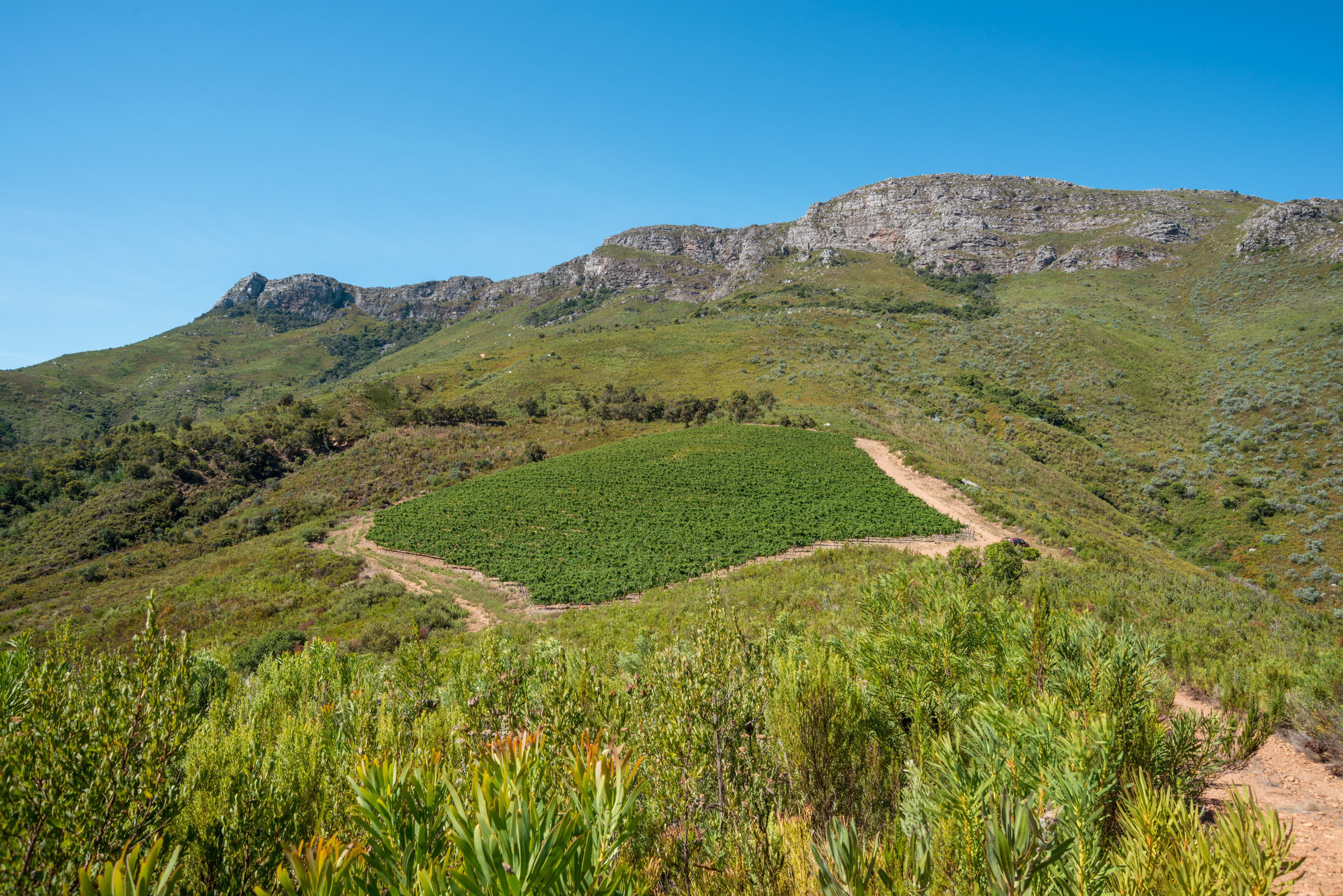
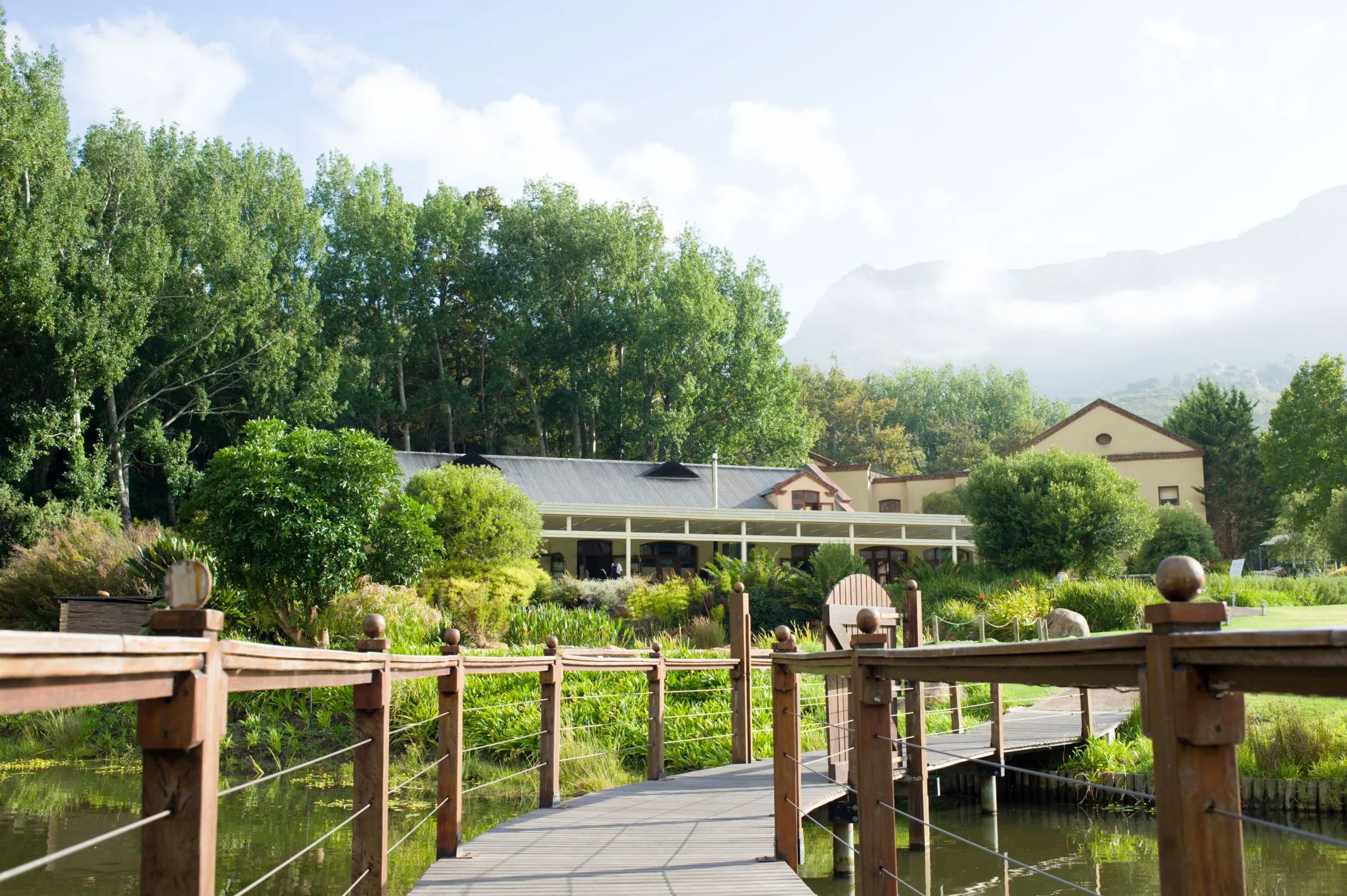
The estate says 80 per cent of the farm is still wild ground with indigenous plants, like the Jonkershoek Nature Reserve next door. The tasting room is a wooden structure on a small island in the middle of a dam, reached by a narrow wooden bridge, with koi in the water below. The Monk Stone vineyard is planted on terraces with a large boulder among them, and the estate says the ripples of the terraces and the boulder recall a traditional Japanese rock garden, hence the name. The highest vineyard, the one Oude Nektar is built around, burned down in 2009 and was replanted. José said in February 2020 that the farm was in its third year of organic farming, and 2022 was the estate’s first certified vintage. Christian Eedes of Winemag gave 97 points to the Oude Nektar 2022. The Stellenbosch Syrah 2022 has five stars in Platter’s 2025 guide, and the Field Blend 2024 and the Monk Stone Chenin Blanc 2024 five stars in Platter’s 2026 guide.
The certificate is held by MAN Vintners (Pty) Ltd, the wine company José co-founded in 2001 with Tyrrel and Philip Myburgh. Ecocert’s EU certificate names the Stark-Condé estate wines from the 2022 vintage on, and records non-organic wine made alongside the organic, so not everything the estate sells is covered. Earlier vintages, still on sale, are not certified, and neither are the Kara-Tara wines sold in the estate’s shop, made from grapes sourced in Elgin, the Overberg and Durbanville, or The Press Club Sauvignon Blanc. The US register lists fewer of the wines, and lists them as made with organic grapes.
“We’re trying to make the best Jonkershoek Valley wines that we possibly can.”
Why it’s remarkable
Free Bacchus Verification
Ecocert EU organic · estate wines from the 2022 vintage
Certified1
- Organic, Ecocert: the EU certificate held by MAN Vintners (Pty) Ltd (ZA-BIO-154.710-0000107.2026.008, valid to 31 March 2027)
This page covers
The Stark-Condé estate wines from the 2022 vintage, named on the EU certificate.
Not covered3
- Earlier vintages still on sale
- The Kara-Tara wines (grapes sourced from Elgin, the Overberg and Durbanville)
- The Press Club Sauvignon Blanc
Also on record2
- The same certificate records non-organic wine made alongside the organic
- The US register (NOP 7880194835, certified since October 2021) lists fewer of the wines, as made with organic grapes
If you’re buying
Cheat sheet
Save it to your phone. Everything you need to recognise this producer, and three things worth saying about it, at a glance in a shop or across a table.
From the Journal
More Verified Houses · South Africa
Photograph across the middle of this page: Stark-Condé vineyard among the fynbos by Kevin Crause, © Stark-Condé, via Stark-Condé Wines. Cropped and resized as one panel of a three-photograph strip for this page.
Photograph across the middle of this page: Sorting the harvest at Stark-Condé by Claire Gunn, © Claire Gunn, via Stark-Condé Wines. Cropped and resized as one panel of a three-photograph strip for this page.