Free Bacchus Journal
The Prettiest Thing
on the Site is plumbing
A distillery in the Yarra Valley is wrapped in more than a mile of copper tubing. Visitors photograph it. Architecture juries have given it prizes. It is also, quietly, a heat exchanger — and that is the whole argument.
Drive up to Four Pillars in Healesville and the first thing you see is the copper. It wraps the building in a veil of fine tubing, catches the light, and on a cold morning has steam rising off it. It reads as pure design gesture, the kind of thing an architect argues for and a client eventually agrees to pay for. It’s a heat exchanger.
More than 1.6 kilometres of copper pipe runs around that building, carrying wastewater off the gin stills. Hot water goes in one end, travels the veil, sheds its heat to the air, and comes out cool enough to return to the distilling process. The steam people photograph on winter mornings is the system working.
It collapses an argument the drinks industry has been having with itself for years. Sustainability is usually discussed as a constraint on design: the thing you give up to do the right thing, the reason your building looks worthy rather than beautiful. Here the requirement produced the most striking thing on the site. Nobody chose between them.
One material, four jobs
Follow the copper and you get the whole building.
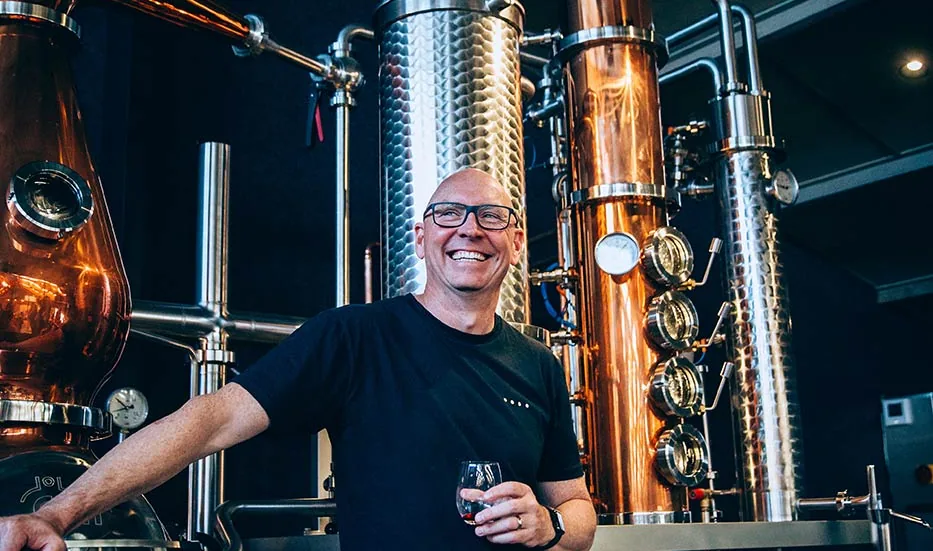
It starts inside, in the German-made stills. Copper has been the still material of choice for centuries because it strips sulphur compounds out of spirit as it condenses: old, unglamorous chemistry that no better material has displaced.
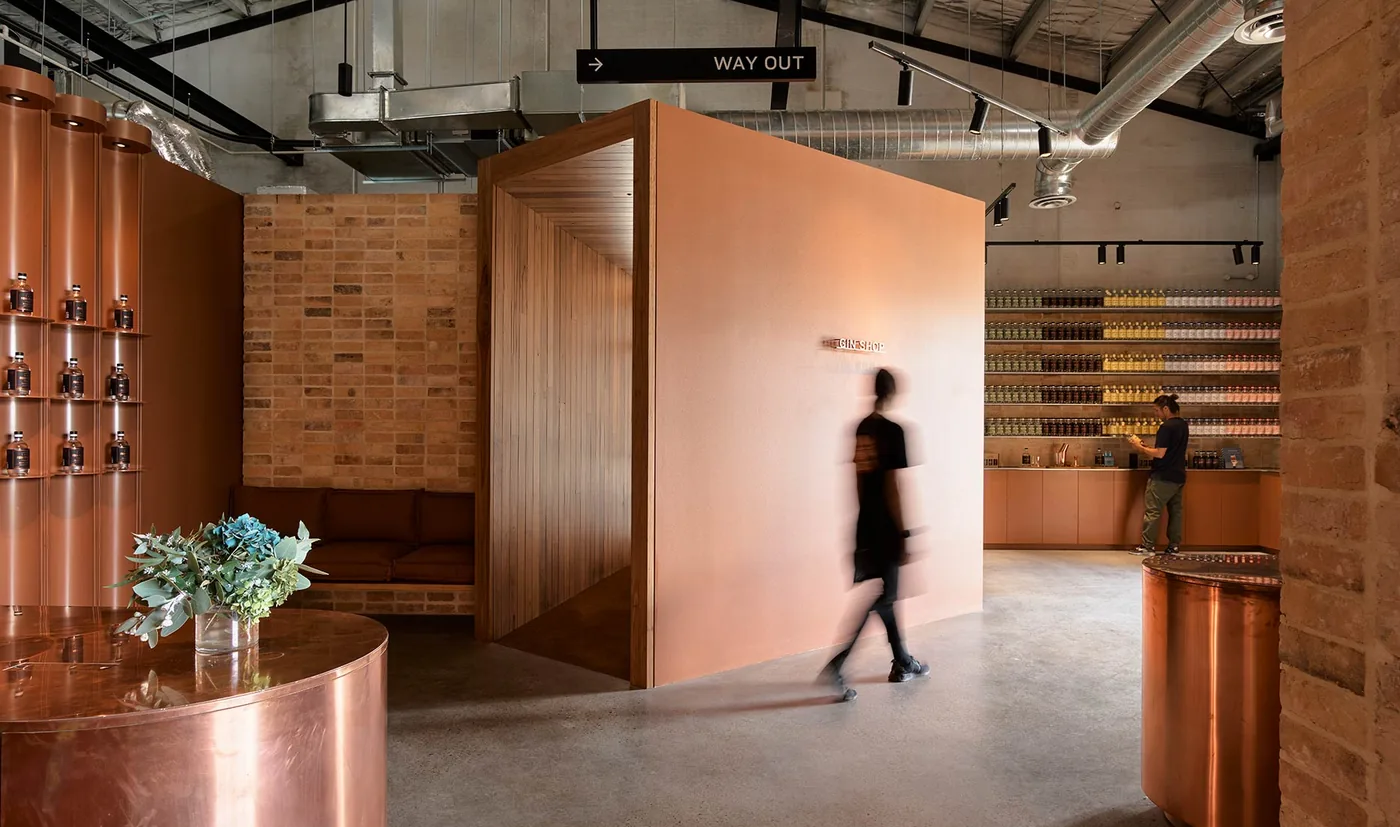
So when Breathe Architecture went looking for a cladding, they took the still metal and put it on the outside. Bettina Robinson, who led the interiors, put the reasoning plainly: copper is a living natural material that will wear and patina gracefully over time. It is also entirely recyclable, rarer in architectural cladding than most people assume.
Then the copper does a third job. Fine pipes run from the production floor to the bar, delivering gin on tap into reusable bottles rather than single-use glass. Breathe puts the saving at around 29 tonnes of glass a year. It is also the most theatrical thing in the room: you watch the spirit arrive from the place it was made, forty metres away.
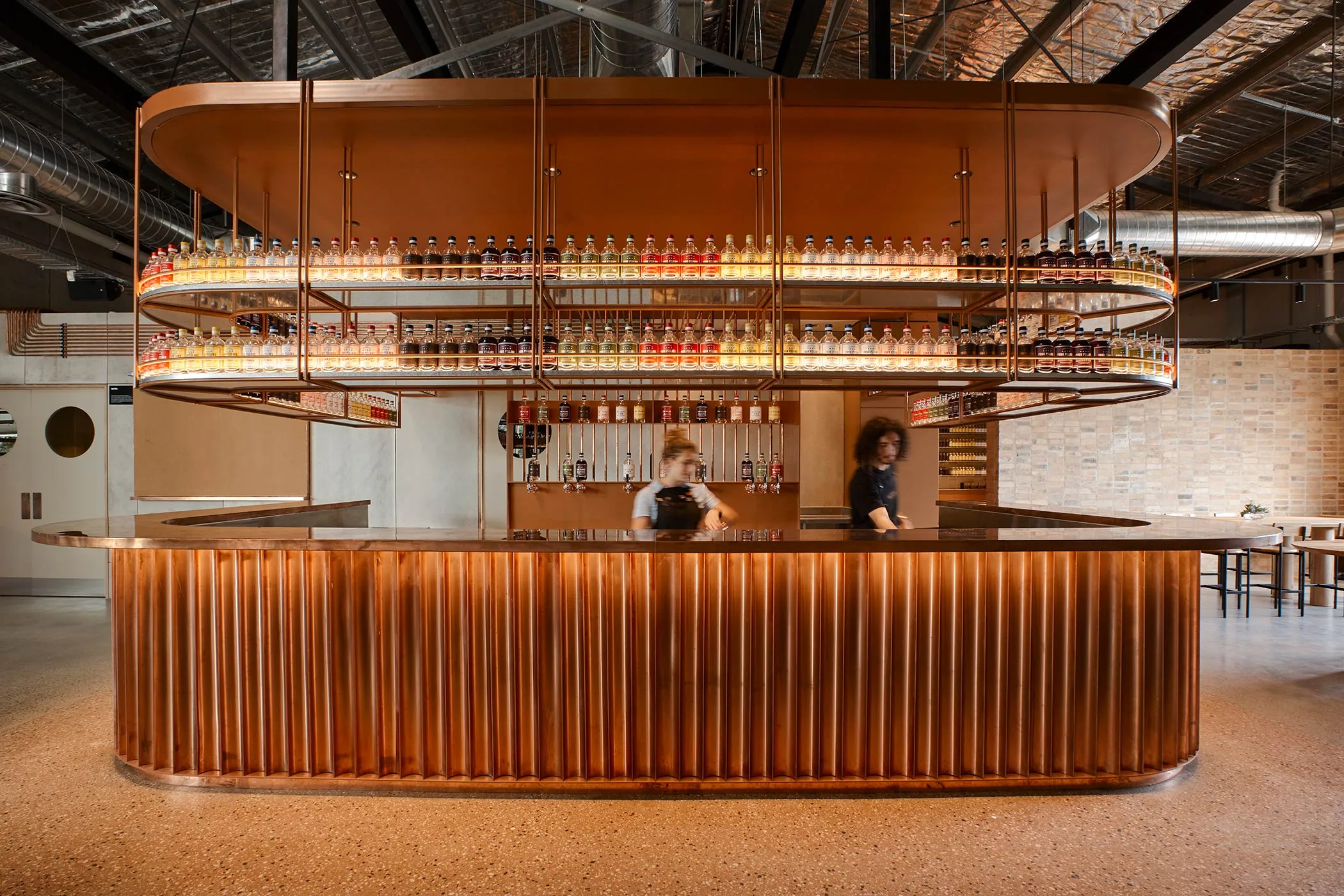
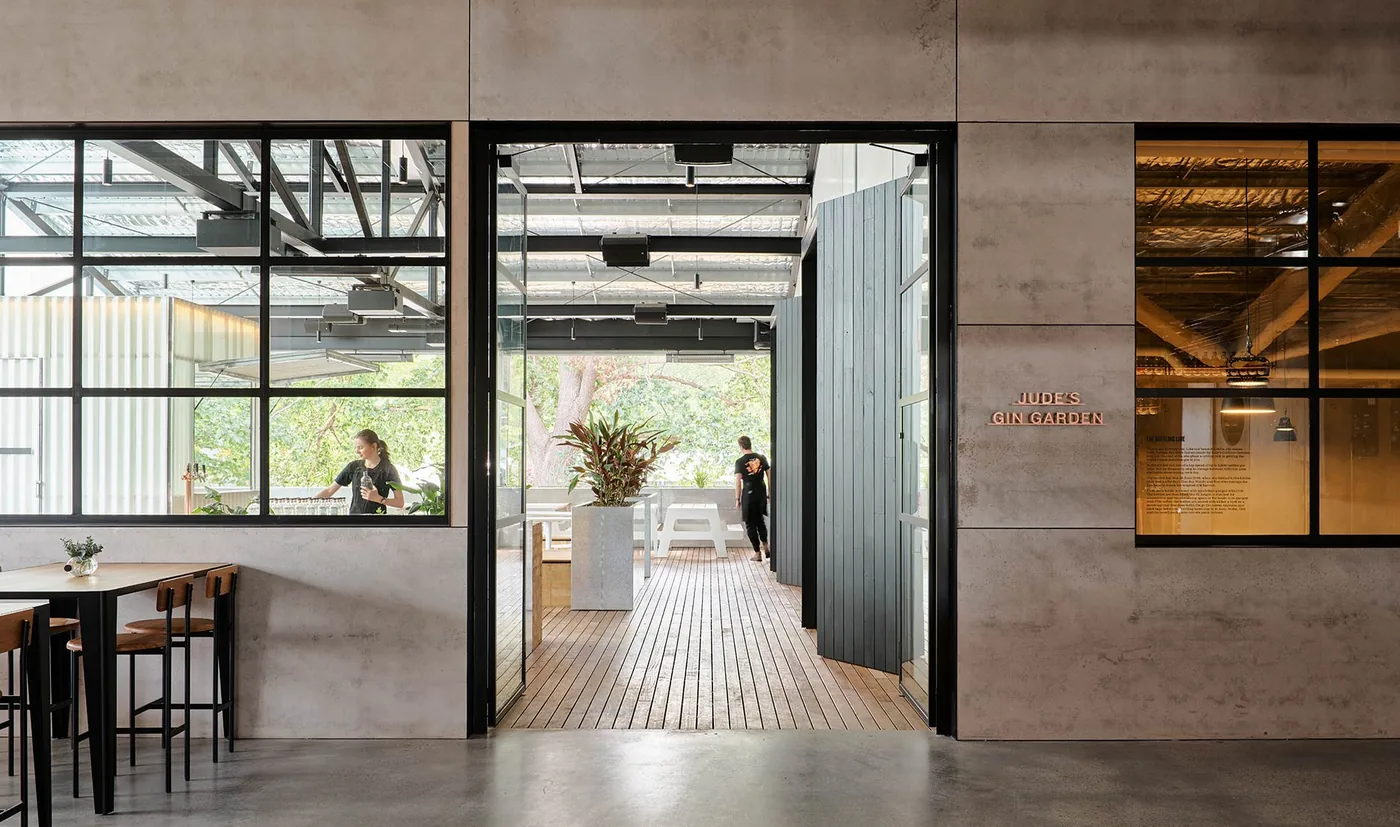
The fourth job is Beth’s Bar itself, the copper-clad centrepiece, visible from every dining area. Port-hole windows look down from the restaurant into the distillery. The craft stays on show rather than tidied away behind a service door.
What the water does next
The most surprising thing about the site isn’t visual at all.
Stillage water, what is left after the botanicals have given up everything, runs through the central courtyard. It is dry and tannic, still carrying the juniper and citrus and pepperberry that went into the gin, and the courtyard smells faintly and continuously of spiced chai.
Nobody designed that as an amenity. It is a by-product of routing process water through the building instead of piping it out of sight. But a visitor walking to the bar is smelling the actual production, which no scent marketing could manufacture and most distilleries have engineered away.
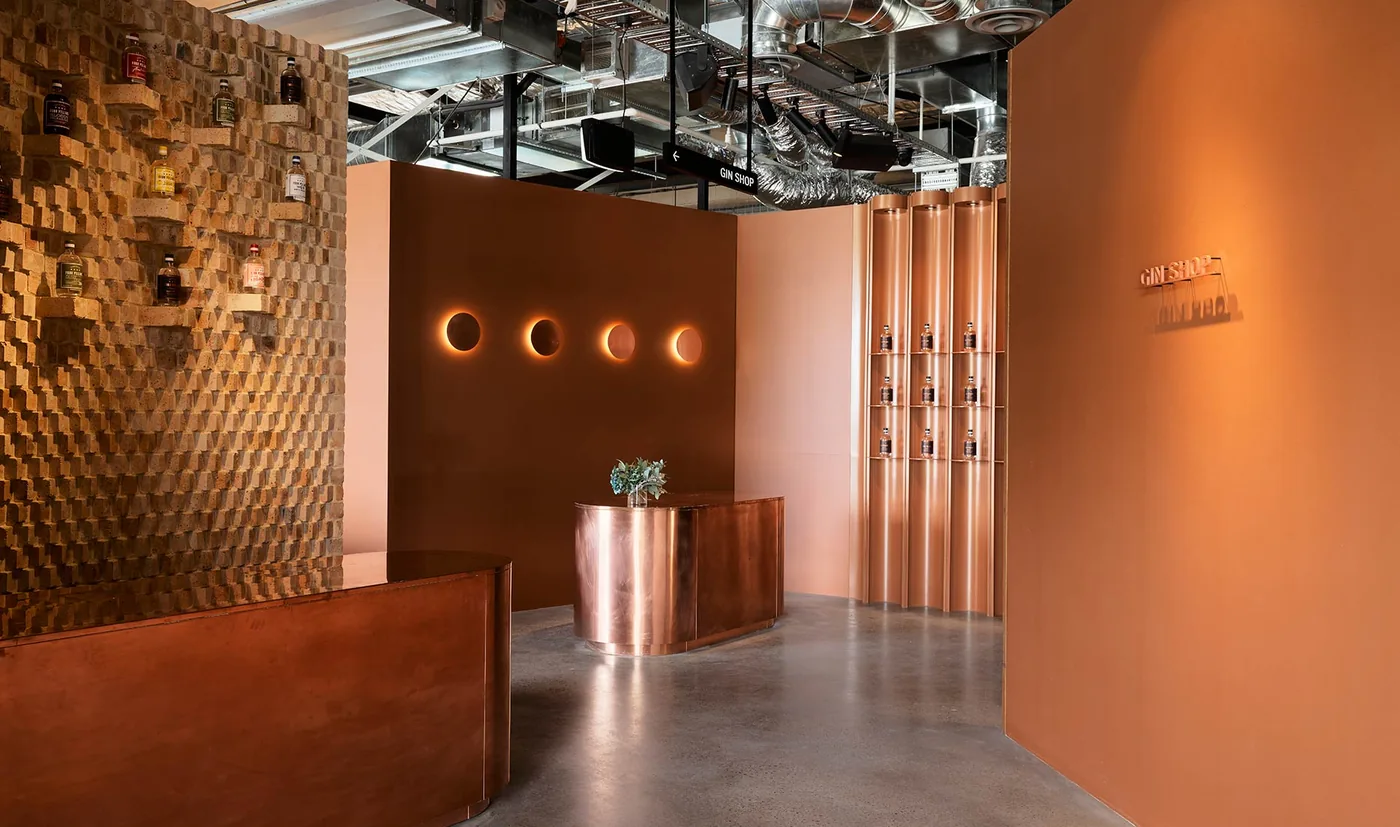
The rest of the record is less poetic and more load-bearing. The building runs without fossil fuels: no gas anywhere in the new development, a fully electric commercial kitchen, a 100kW rooftop solar array. During construction all steel, concrete and timber waste was recycled and none of the excavated material went to landfill. The palette is recycled brick, solid timber, a coir and timber entry portal, and upholstery made from pineapple waste fibre on locally built furniture.
Robinson’s phrase for the palette is perfectly imperfect: materials chosen because a scratch or a knock does not diminish them. A surface that looks worse every year gets replaced. A surface that looks better every year does not.
The part we should be honest about
This cost seven million dollars.
There is a version of this article that holds Four Pillars up as a rebuke to every distillery that hasn’t done the same, and it would be unfair. A closed-loop copper heat exchanger is not available to a producer working out of a shed with a second-hand still and a bank covenant. Most distilleries are not choosing decoration over function; they are choosing between a new fermenter and a new roof.
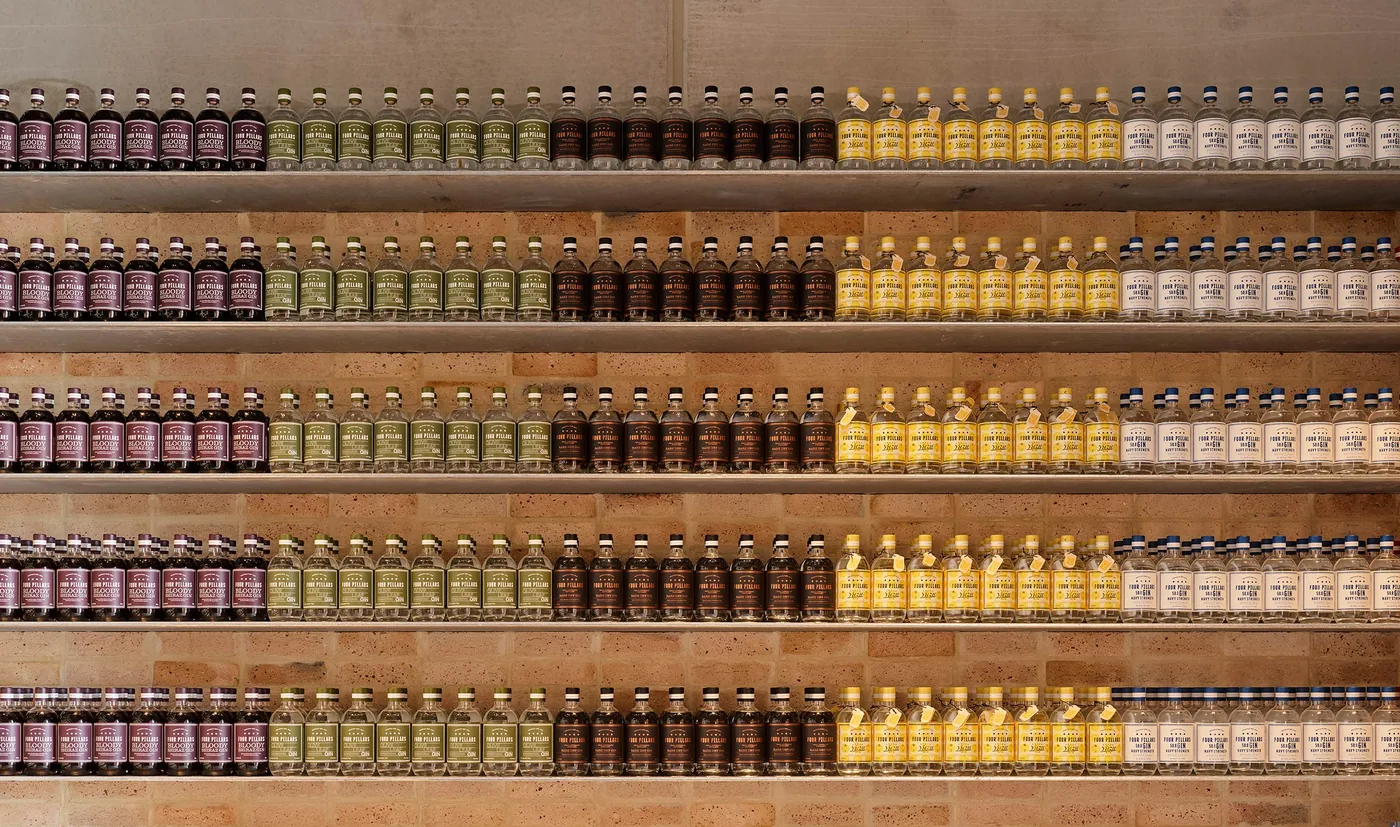
What it demonstrates is narrower. When a producer does have capital to spend on a building, and in premium spirits plenty do, the default is to spend it on the appearance of heritage: brass, leather, dark timber, a wall of old bottles, the vocabulary of a distillery from a century ago. That is the norm, it is expensive, and it does nothing at all.
The gin has to be good, and it is
None of it would matter if the spirit were an afterthought, which is where many sustainability stories quietly fall apart.
Four Pillars was founded in 2013 by Cameron Mackenzie, Matt Jones and Stuart Gregor on a straightforward proposition: an Australian gin ought to taste Australian. Tasmanian pepperberry, lemon myrtle, finger lime and wattleseed sit alongside the juniper the category legally requires. They are not garnishes on a London Dry recipe; they are the reason the gin tastes of somewhere.
The sourcing runs deeper than the botanical list. The oranges are grown specifically for the distillery rather than bought on the open market, which turns a sourcing claim into something checkable. Spent citrus goes to a neighbouring winery rather than to waste. The B Corp certification covers the entire operation rather than a single product line.
And it holds up under blind assessment. The Rare Dry Gin has taken 95 points from Decanter and gold at the International Wine and Spirit Competition, which awarded Four Pillars its Global Green Spirit Trophy in 2022. The building won its category at the Sustainability Awards that year and was shortlisted at the Victorian Architecture Awards and the Eat Drink Design Awards. Very few producers are judged well by architecture juries and spirits judges in the same twelve months.
The habit worth taking
We list Four Pillars at Gold tier, verified through B Corp certification covering the whole operation alongside documented botanical sourcing. The building is not part of that assessment: our standard measures farming and production, not architecture, and we would rather say so than let a beautiful distillery flatter a verification it played no part in.
The building tells you something the certification cannot.
Next time you are somewhere that has spent real money on looking a particular way — a distillery, a cellar door, a restaurant clearly designed rather than merely fitted out — pick the most striking object in the room and ask what it does. Most of the time the answer is nothing. It is cladding, and there is no shame in that; rooms are allowed to be pleasant.
Occasionally the answer is that it is cooling the water, carrying the product, or holding up the roof. When a producer’s aesthetics and their operations turn out to be the same decision, somebody has thought hard about both. That is a reasonable proxy for how they think about everything else, including what happens in the field.
The receipt
What to take from this
- The copper veil at Four Pillars is over 1.6km of tubing that cools wastewater from the stills so it can re-enter distilling.
- Copper does four jobs on the site: still metal, cladding, the gin line to the bar, and the bar itself — and it is fully recyclable.
- Gin piped directly to the bar rather than bottled saves roughly 29 tonnes of glass a year.
- The $7m building is fossil-fuel free with a 100kW solar array; no excavated material went to landfill.
- Honest limitation: this took serious capital. The point is not that everyone can do it, but where the money goes when it exists.
- The gin stands on its own — 95 points from Decanter, IWSC gold, and the IWSC Global Green Spirit Trophy in 2022.
Where the claims come from5
-
ArchitectureAU — Coated in copper: Four Pillars Gin Distillery
architectureau.com ↗ -
Breathe Architecture — Four Pillars Gin Distillery project record
breathe.com.au ↗ -
Breathe Architecture — Four Pillars Distillery 2.0 now open
breathe.com.au ↗ -
Australian Institute of Architects — Four Pillars Gin Distillery 2.0, Victorian Architecture Awards
architecture.com.au ↗ -
Free Bacchus — Four Pillars Gin, Gold Tier producer profile
↗