Free Bacchus Journal
Champagne Isn’t Dying.
its cheapest bottle is
Shipments have fallen three years running and are at a twenty-year low. Meanwhile the 2026 harvest began earlier than any on record, after frost destroyed nearly half the potential crop. Both of those are true, and they are not the same story.
In August 2026, growers in Champagne began picking earlier than at any point in the region’s recorded history. Heat had run the season forward by weeks. They were harvesting a crop that had already lost, by the Comité Champagne’s own estimate, forty-three percent of its potential production to frost.
An early budburst pushed tender shoots out ahead of schedule, and a frost afterwards killed them. Drought through the summer made the remainder worse. That is what climate change looks like on the ground in a cool-climate wine region.
At the same time, and for reasons that only partly overlap, shipments have been falling. Which has produced a lot of headlines asking whether Champagne is finished.
It isn’t. But something inside it is, and separating the two is the useful work.
The earliest picking on record, of one of the smallest crops on record. Those aren’t two facts. They’re the same one.
The numbers, which are genuinely bad
Champagne shipped 326 million bottles in 2022. That was the post-pandemic high, and everything since has gone one way.
2023 brought 299 million, a fall of eight percent. 2024 brought 271 million, down another nine. And 2025 closed at 266 million, a further two percent. Three consecutive years of decline, sixty million bottles gone, and the lowest volume in two decades outside the pandemic year of 2020.
Revenue tells the same story with less cushioning. The appellation turned over €5.17 billion in 2025, down eleven percent on the €5.8 billion of 2024, against a peak of €6.3 billion in 2022. Volume fell two percent and revenue eleven: the mix shifted as well as the total.
Nobody senior expects a quick recovery. Bollinger’s chief executive has said no overall rebound is expected for 2026. The co-president of the Comité Champagne has suggested the region’s traditional 300 million bottle benchmark is unlikely to be reached for three to five years, given how slow and costly it is to open new markets. And a strong euro plus American tariffs could push prices in Champagne’s largest export market up by as much as a quarter.
By the numbers
since 2022, a fall of eighteen percent.
a tenth — while Prosecco rose 9%.
for 2026 — a fourth straight cut.
But look at which Champagne left
Here is the number that reframes everything, and it comes from the French domestic market, which is the region’s single largest and has been falling hardest.
Champagne sales through French supermarkets fell to 26.6 million bottles, down ten percent in a year. Over the same period, Prosecco sales through those same supermarkets rose nine percent to over 21 million bottles, and crémant reached 47 million, up one percent.
The French domestic market has now contracted by more than a third since 2010, and the collapse is concentrated in entry-level cuvées sold on shelf beside everything else.
That’s not a mystery, and it isn’t really about Champagne’s quality. An inexpensive supermarket Champagne was never competing on what was in the bottle. It was selling a word, the most valuable word in drink, at a price where the word was most of the value. When money got tighter, a large number of people worked out that Prosecco does the fifteen-euro job perfectly well.
Meanwhile, the other end has been quietly holding up. Reporting through 2026 notes that the rate of decline has slowed sharply, that several leading houses have returned to growth, and that grower Champagnes and by-the-glass programmes are among the parts finding success.
Shoppers didn’t stop buying sparkling wine. They stopped paying a premium for a word, and crémant uses the same method anyway.
Now the vineyard, which is a separate problem
Underneath the commercial story is an agricultural one, and it has been getting steadily worse for a decade.
In 2021 Champagne recorded its smallest crop since 1957. A warm March pushed budburst early, April frosts killed the new shoots, and then heavy June and July rain produced downy mildew that moved through humid vineyards fast. Hail took at least 500 hectares outright. Roughly thirty percent of the crop went to frost, and another quarter to thirty percent to mildew. Regional production fell by around a third, the lowest agronomic yield in forty years, and France lost something in the order of two billion dollars in Champagne sales.
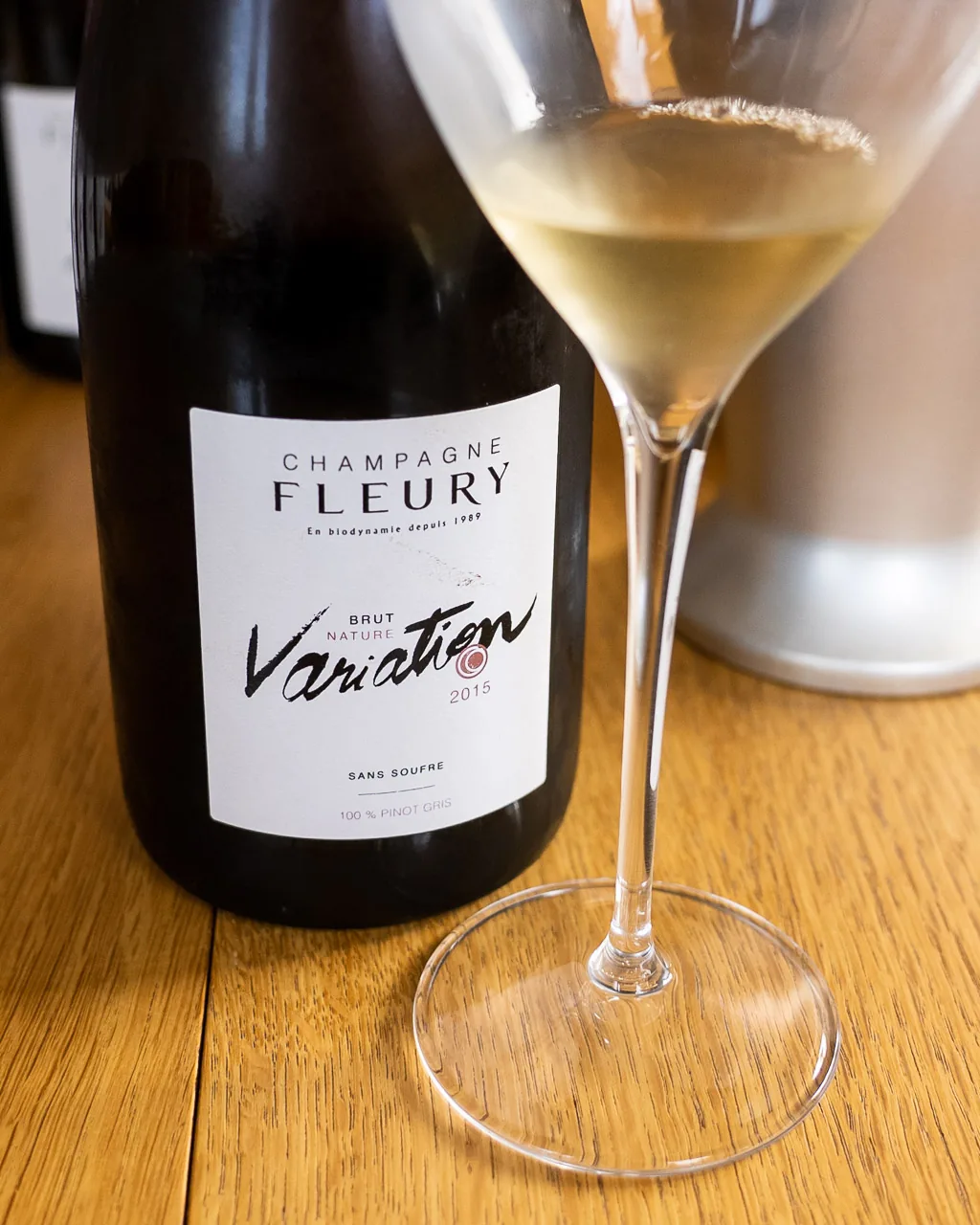
2024 was wet rather than frozen. Rain fell across the appellation from the previous October onwards, mildew pressure was severe, and yields varied wildly — some parcels came in around 2,000 kilograms per hectare against a regional target several times that. Champagne Fleury in the Aube, the first house in the region to convert to biodynamics, lost as much as ninety-five percent of its crop and shared a pressing facility with a neighbour rather than run its own for what was left.
And 2026 brought the frost figure at the top of this article, then drought, then the earliest picking anyone has recorded.
The direction of travel in permitted yields tells the same story from the administrative side. In 2010 the region was working to 10,500 kilograms per hectare and shipped 319.5 million bottles. The marketable yield was 10,000 in 2024, 9,000 in 2025, and 8,800 for 2026. That is the fourth consecutive annual cut.
The complication worth being honest about
It would be tidy to say the falling yields are simply climate, and therefore that Champagne is becoming more expensive to make. That’s partly true and partly not, and the distinction matters.
The marketable yield in Champagne is not set by the weather. It’s negotiated annually between growers and houses, and it determines how much of the harvest may be sold as Champagne at all. It is one of the most consequential commercial decisions the region makes each year, and it responds to expected demand as much as to conditions in the vineyard.
The Champagne Bureau’s own framing of the 2025 cut was that it was a cautious response to market realities and a way to ensure balance, and that in principle nothing stops the figure rising again. Reporting on the 2026 cut describes it as reflecting two pressures at once: an uncertain economic outlook, and recurring weather shocks. Analysts have made the further point that because Champagne is a luxury product with managed stock levels, deliberate supply control tends to influence its price more than climate fluctuation does.
So the yield is falling for two different reasons that currently happen to point the same way, which makes them easy to confuse: demand softened, so the region released less, and the weather also delivered less.
The reason to keep them separate is that they behave differently over time. If demand recovers, the quota can be raised again by agreement, in a single meeting. If the growing conditions keep degrading, no meeting fixes that — and only that one is a reason to expect Champagne to become structurally more expensive to produce.
Where the pressure lands hardest
There’s a cruel detail in all of this that we keep running into across every region we look at, and Champagne shows it more clearly than most.
A warmer, wetter, more volatile climate is a climate more hospitable to fungal disease. Mildew and rot thrive in humidity and unseasonal rain, and 2021 and 2024 were both, at root, disease years rather than heat years. The grower with a full conventional spray programme has instruments to reach for when a wet June arrives. The grower who has given up synthetic fungicides has fewer, and in a bad enough season may have none that work.
Which is why Champagne Fleury losing ninety-five percent of a crop is the detail we’d hold onto. Fleury converted to biodynamics in 1989 — the first house in the appellation to do so, on the certifying syndicate’s own record — and has farmed that way for over thirty-five years, through a period when the rest of the region considered it eccentric. That commitment is precisely what left them most exposed in a mildew year.
Roughly eight percent of the Champagne vineyard is engaged in organic certification: 2,762 hectares across 631 estates in 2023, on figures compiled by Agence Bio and Bio en Grand Est. That counts land still converting as well as land already certified, which is worth saying plainly, because the distinction is usually lost. That figure is low, and it’s often cited as evidence of complacency in a prestigious region. The seasons of the last five years suggest a more sympathetic reading is also available: clean farming here is genuinely hard, it is getting harder, and the growers doing it are absorbing losses that conventional neighbours are not.
What this means if you’re buying
Three practical things follow, none of which require you to care about yield quotas.
First, the price of a grande marque was never mostly the price of the farming. It is the advertising, the ambassadors, the boxes, the decades of brand-building. So when costs rise and prices rise with them, the increase isn’t landing on a bottle whose value was agricultural in the first place.
Second, the part of Champagne that’s growing is the part where a named grower farms their own chalk and bottles their own harvest. That’s also where nearly all the region’s interesting clean farming sits. Grower Champagne is not a compromise on the famous names; bottle for bottle it frequently outperforms them, because the money went into the wine rather than the campaign.
Third, the method is not the place. Crémant is made by the identical process outside the Champagne boundary, and several certified biodynamic producers make it very well for a fraction of the price. The bubbles don’t know which appellation they’re in.
So, is it dying?
No, but a version of it is, and honestly that version was always the least interesting one. Cheap Champagne sold on the strength of the name is being competitively dismantled by Prosecco and crémant, which do the same job for less and never pretended otherwise. That’s a market correcting a premium that had drifted away from what was actually in the bottle.
The genuine threat to Champagne isn’t demand. It’s the growing season. Frost after early budburst, mildew in wet summers, drought in hot ones, harvests arriving earlier every decade. Those are the conditions that determine whether the region can keep making this wine at all, and they’re the conditions no trade negotiation or marketing campaign will improve.
The next time you see a headline about Champagne’s decline, the question worth asking is which number moved: the one the region chose, or the one the weather chose. They tell completely different stories, and only one of them keeps getting worse.
The receipt
What to take from this
- Champagne isn’t dying. Its cheapest tier is being beaten by Prosecco and crémant, while the weather quietly becomes the real problem.
- Sales really have fallen three years straight: 326 million bottles in 2022, 266 million in 2025. Sixty million gone, and the lowest volume in twenty years outside the pandemic.
- But look at which bottles left. Supermarket Champagne in France fell ten percent to 26.6 million bottles. In the same shops Prosecco rose nine percent and crémant reached 47 million.
- The cheap stuff was selling a word. When money got tight, buyers noticed Prosecco does the fifteen-euro job — and crémant uses the exact same method as Champagne.
- The vineyard is the real story. 2021 was the smallest crop since 1957. In 2026 frost destroyed forty-three percent of the potential crop before the earliest harvest ever recorded.
- Two different things are shrinking yields. The amount growers may sell is negotiated annually and has been cut four years running, partly because demand fell. That can be reversed in a meeting. The weather can’t.
- Clean farming is hardest exactly where it’s needed. Champagne Fleury, biodynamic since 1989 and the first house in the appellation to convert, lost up to ninety-five percent of its 2024 crop to a mildew year.
- The growth is in grower Champagne, where a named farmer works their own chalk — and crémant makes the same wine by the same method, well outside Champagne prices.
Where the claims come from12
-
The Drinks Business — Global Champagne shipments fall by 2% in 2025
thedrinksbusiness.com ↗ -
The Drinks Business — Champagne market shows signs of recovery after years of decline
thedrinksbusiness.com ↗ -
Terroir Champagne — Champagne sales continue to decline (supermarket, Prosecco and crémant figures)
terroir-champagne.com ↗ -
Vinetur — Champagne growers begin earliest harvest on record after frost destroyed 43% of potential production
vinetur.com ↗ -
Vinetur — Champagne will start its 2026 grape harvest earlier than ever recorded (yield quotas)
vinetur.com ↗ -
Vinetur — Frost and rain ravage Champagne vineyards (2024 harvest, Fleury losses)
vinetur.com ↗ -
The Drinks Business — Everything you need to know about the current Champagne yield
thedrinksbusiness.com ↗ -
Zero Carbon Analytics — Climate change is leading to less and worse-tasting sparkling wine
zerocarbon-analytics.org ↗ -
CNBC — Extreme heat spurs earliest-ever Champagne harvest
cnbc.com ↗ -
Vinovistara — Champagne sales decline: industry forecasts no recovery in 2026
vinovistara.com ↗ -
Biodyvin (SIVCBD) — Champagne Fleury, member record: Courteron, Labellisé Biodyvin, biodynamic conversion 1989
biodyvin.com ↗ -
La Champagne Viticole — Agence Bio and Bio en Grand Est figures: 2,762 ha engaged in organic certification, 8% of the vineyard
lachampagneviticole.fr ↗